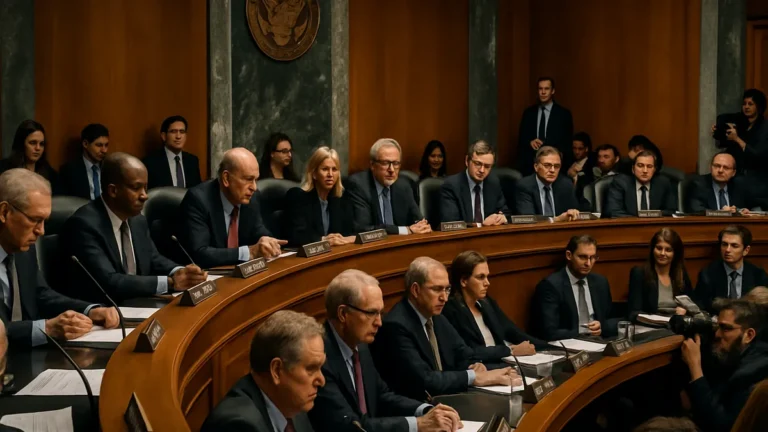

Sen. Adam Schiff and Rep. Mike Levin have introduced the DEATH BETS Act to stop a specific slice of prediction markets: contracts on terrorism, assassination, war, and individual deaths. The important change is not just political messaging or ethics language; it would write those prohibitions directly into the Commodity Exchange Act and remove room for a CFTC-registered venue to list them while regulators debate case by case.
The gap lawmakers are trying to close
The bill responds to real trading activity, not a hypothetical edge case. In recent months, markets tied to Iran escalated scrutiny after traders placed large wagers on military strikes and on the death of Ayatollah Ali Khamenei, exposing how violent geopolitical events could be packaged as tradable contracts before U.S. rules had been made fully explicit for this category.
That matters for market structure because regulatory discretion cuts both ways. If the Commodity Futures Trading Commission has to weigh these contracts one by one, platforms can test boundaries faster than Washington can resolve them; the DEATH BETS Act tries to end that by barring any CFTC-registered entity from listing contracts tied to death, war, terrorism, or assassination at all.
Why this is a regulatory change, not just a moral objection
A common misread is to treat the proposal as symbolic outrage over distasteful markets. The draft does carry moral and national security concerns, but its practical effect is narrower and more concrete: it would hard-code a no-list rule for federally regulated prediction venues, rather than leaving those venues to rely on evolving guidance, contested interpretations, or delayed enforcement.
CFTC Chairman Michael Selig has acknowledged that prediction markets need a broader regulatory framework as the sector grows and as these contracts increasingly claim forecasting value. Congress is moving in a different direction for this subset of products by saying some event contracts should not be decided by regulator discretion at all, especially where violence, death, or military action could intersect with sensitive information and create incentives that look closer to abuse than price discovery.

Kalshi, Polymarket, and where enforcement actually bites
The platform split is central. Kalshi operates as a federally regulated venue and has already refunded controversial Iran-related markets, which shows how direct U.S. oversight can force immediate product changes even before Congress acts; Polymarket, by contrast, operates offshore and remains largely outside routine U.S. regulatory reach, so the same congressional fix does not land on both businesses in the same way.
That distinction is why the bill should be read as a market-access and listing rule first. It can constrain what registered U.S. venues offer, reduce the legitimacy of these contracts in regulated channels, and shape future CFTC rulemaking, but it does not by itself eliminate offshore demand or fully solve cross-border enforcement. For crypto-adjacent traders, that means liquidity may not disappear so much as migrate, with regulated depth shrinking first and unregulated order flow remaining harder to police.
| Issue | DEATH BETS Act effect | What it does not fully solve |
|---|---|---|
| Death, war, terrorism, assassination contracts on CFTC-registered venues | Would be explicitly prohibited in statute | Offshore platforms can remain harder to reach |
| Regulatory discretion | Reduced by codifying a blanket ban for these categories | Does not settle every other prediction-market category |
| Insider trading concerns | Indirectly addressed by removing some sensitive markets from regulated listing | Separate legislation is still needed for officials misusing non-public information |
The companion bills widen the target beyond one headline market
The DEATH BETS Act sits inside a broader congressional push. The End Prediction Market Corruption Act, backed by Sens. Jeff Merkley and Amy Klobuchar, would impose civil penalties on government officials who trade on prediction markets using non-public information, directly answering concerns raised after reports that one trader made more than $500,000 on Iran-related bets shortly before military strikes began.
Another bipartisan proposal from Reps. Blake Moore and Salud Carbajal would reaffirm existing bans on assassination, war, terrorism, and gambling contracts while adding politics to the prohibited event-contract list under the Commodity Exchange Act. Taken together, the message is not simply that one controversial market went too far; lawmakers are trying to redraw the boundary between acceptable forecasting products and contracts that look like political gambling, violence-linked speculation, or an information abuse channel.
The next checkpoint is rulemaking, not rhetoric
Passage is not assured in a divided Congress, and Republican resistance could slow or block the package. But the nearer-term signal for traders and platforms is whether the CFTC moves to formalize tougher prediction-market rules while Congress debates statutory language, because agencies can still influence listings, approvals, and enforcement priorities before a bill becomes law.
For anyone tracking what is signal versus narrative, the useful checkpoint is simple: watch for formal CFTC actions, bill text movement, and platform responses to sensitive contracts. If regulated venues start pulling similar markets, tightening listing standards, or preemptively refunding contracts as Kalshi did, that is stronger evidence of policy risk than political commentary alone.
Quick questions traders are likely to ask
Does this ban all prediction markets?
No. The bill is aimed at contracts tied to terrorism, assassination, war, and individual deaths, not the entire category.
Would Polymarket be shut down in the U.S. by this bill alone?
Not cleanly. The bill is most direct for CFTC-registered entities, while offshore enforcement remains the harder problem.
What is the clearest practical consequence if the bill advances?
Regulated U.S. venues would face a statutory line they cannot test, which would likely reduce compliant liquidity in these contracts even if offshore trading continues.
About the Author