
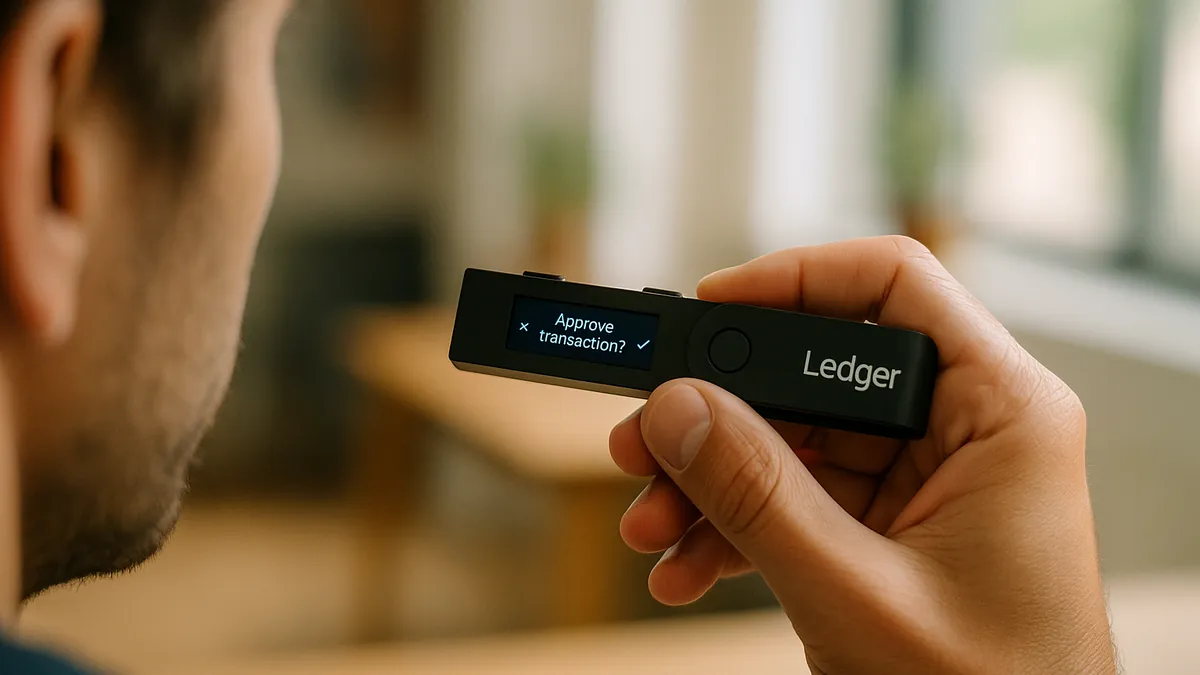
Ledger’s new integration with MoonPay is not a handoff of wallet control to AI agents. It is a gated model: the agent can propose a trade, but the user still has to physically approve every transaction on a Ledger device, keeping private keys inside hardware while allowing automated strategies to operate across multiple chains.
Automation now stops at the device screen
MoonPay’s AI Agents now work through a command-line interface wallet that integrates Ledger’s Device Management Kit for transaction signing. In practice, an agent can detect a portfolio rebalance or trading opportunity, generate the transaction, and send it for review, but execution only happens after the user confirms it on a Ledger Nano S Plus, Nano X, or Stax.
That distinction matters because the common reading of “AI trading integration” is usually full autonomy. This setup is narrower and more controlled. The agent handles monitoring and proposal generation; the hardware wallet remains the signing boundary. For self-custody users, that is the core feature, not a footnote.
Why this differs from the usual bot setup
Traditional crypto bots often rely on software wallets or hot wallets that keep signing authority accessible to the application itself. That creates a direct path from compromised code, leaked credentials, or prompt-injected agent behavior to asset loss. Ledger’s model removes that path by ensuring private keys never leave the hardware wallet.
The “air-gapped” framing here is not marketing shorthand so much as a market-structure constraint. If the AI cannot sign on its own, then strategy speed is limited by human approval, but the blast radius of a bad model output is also sharply reduced. That trade-off makes the product less suitable for fully latency-sensitive execution and more suitable for users who want automated detection and workflow support without surrendering final control of assets.
It also creates a cleaner audit trail. Every approved action passes through a visible confirmation step on the device, which is materially different from bots that can keep firing transactions in the background until a user notices something is wrong.
Supported chains are live, but the real test is standardization
The integration launches with support for Ethereum, Solana, Optimism, Avalanche, and Base. That list is useful because it covers both major base layers and active execution environments where AI-assisted portfolio actions could plausibly be used. It also signals that MoonPay and Ledger are trying to make this work beyond a single-chain demo.
But multi-chain support is not just a distribution point. Each network has different transaction formats and signing requirements, so reliable hardware approval depends on how well those differences are normalized in the interface. A secure Ethereum signing flow does not automatically translate to Solana or an L2 environment. If this model is going to expand from retail experimentation to serious operational use, consistency across chains will matter as much as adding more logos to the support list.
Signal versus narrative: security and compliance are ahead of full autonomy
The stronger signal in this launch is not “AI now trades crypto for you.” It is that wallet infrastructure is being redesigned around constrained agent behavior. MoonPay says the system includes transaction logging, user ID verification, and suspicious activity monitoring aligned with MiCA requirements in Europe. Those controls point toward a compliance-ready operating model rather than a pure retail automation story.
That is also where the institutional angle starts to become credible. MoonPay CEO Ivan Soto-Wright framed the issue around oversight, while Ledger Chief Experience Officer Ian Rogers pointed to demand for developer wallets with hardware security as AI use expands. Institutions are unlikely to adopt agent-based trading if signing authority lives in a hot environment with weak accountability. A hardware approval layer, plus logging and identity controls, addresses that objection directly, even if it does not solve for speed.
| Model | Who can sign | Key exposure risk | Operational trade-off | Fit |
|---|---|---|---|---|
| Typical software bot | Bot or app signs directly | Higher, because keys or signing access sit in software | Faster execution, weaker control boundary | Latency-sensitive automation, higher custody risk |
| Ledger-MoonPay hardware approval model | User signs on Ledger device | Lower, because private keys stay on hardware | More friction, stronger user oversight and auditability | Self-custody users, compliance-conscious teams, staged institutional use |
The next checkpoint is not more AI, but better control design
The next practical test is whether Ledger and MoonPay can extend this model without weakening the approval boundary. Expanded blockchain support is one checkpoint. Multi-signature support is another, especially for firms that need team-based authorization rather than a single device owner approving every action. Those features would make the system more relevant for treasury operations and structured trading workflows.
If you are evaluating this setup, the key question is simple: do you need autonomous execution, or do you need autonomous analysis with human-controlled signing? This product clearly fits the second category. Treat it as infrastructure for supervised agents, not as permission for unattended AI asset control.
Short Q&A
Does the AI agent get access to the private key?
No. The private key stays on the Ledger hardware wallet and does not move into MoonPay’s agent environment or the CLI wallet.
Can this be considered fully autonomous trading?
No. Every transaction still requires physical user approval on the device.
What should users watch next?
Whether support expands beyond Ethereum, Solana, Optimism, Avalanche, and Base, and whether multi-signature workflows arrive without diluting the hardware approval model.
About the Author