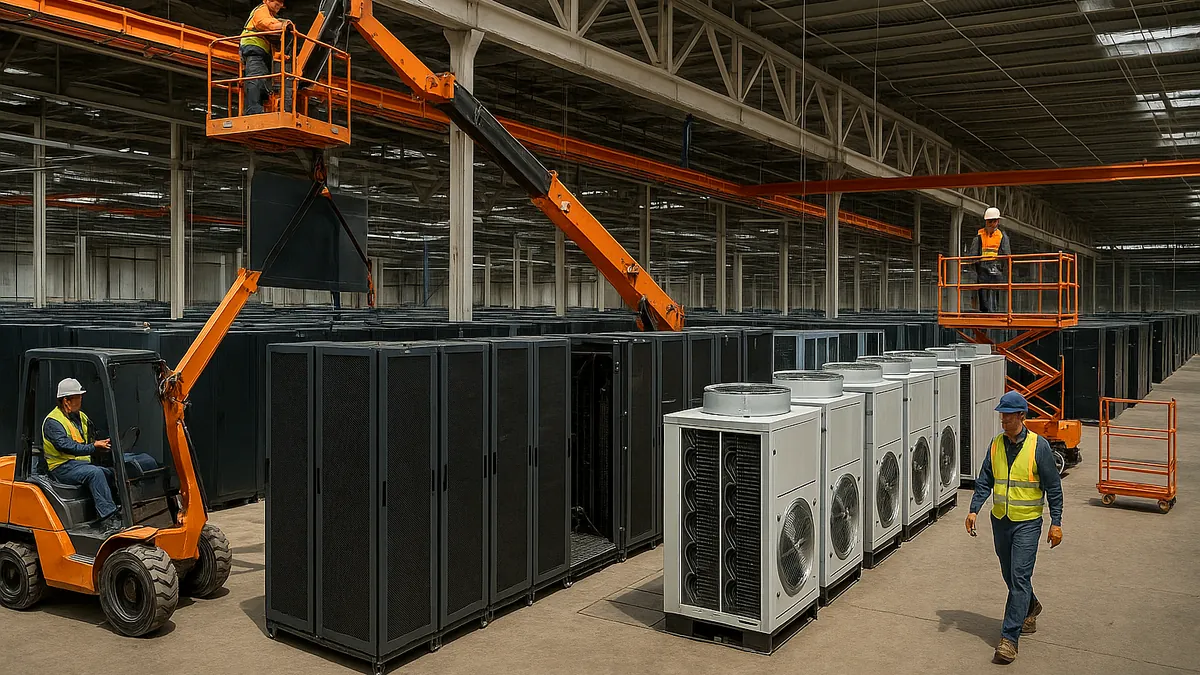
Cipher Digital’s latest announcements are not just a growth update. The 15-year lease for a third high-performance computing campus and the new $200 million revolving credit facility show a miner remaking itself into an AI infrastructure operator, but on terms that tie expansion to strict liquidity, valuation, and lender controls rather than open-ended optimism.
The lease changes the business mix, not just the project pipeline
Cipher said it signed a 15-year lease with an investment-grade hyperscale tenant to build a third HPC data center campus at an existing site. That matters because it moves the company further away from dependence on bitcoin mining economics and toward contracted infrastructure revenue tied to large AI and cloud workloads. A long-duration lease with a hyperscale customer is a different type of asset backing than spot-exposed mining output.
The distinction is important for crypto investors because the market can misread this as a generic diversification story. It is more specific than that: Cipher is trying to replace a business driven by hashprice, network difficulty, and bitcoin volatility with one supported by long-term counterparties and industrial power-and-land development. The tenant being described as investment-grade also signals that the credit quality of the customer is part of the investment case, not a side detail.
The bank syndicate is backing a transition, but only inside a tight capital structure
Alongside the lease, Cipher secured a $200 million revolving credit facility with a $50 million accordion option. The facility was undrawn at closing and matures in March 2030. Morgan Stanley is the agent, and the lender group includes Goldman Sachs, JPMorgan Chase, Wells Fargo, Banco Santander, and Sumitomo Mitsui. For a company still identified by many investors as a bitcoin miner, that lender lineup is a concrete signal that traditional capital is willing to finance the AI data center buildout.
But the cleaner read is not simply “major banks are bullish.” This is a controlled financing package. Pricing sits at SOFR plus 1.25% to 1.75%, with step-down margins linked to Cipher’s debt-to-market capitalization ratio, which means the facility rewards balance-sheet discipline and a stronger equity cushion. The structure gives Cipher non-dilutive funding flexibility, yet it also shows lenders are underwriting a transition with measurable guardrails rather than giving the company unrestricted growth capital.
The real constraint is access to the revolver, not the headline size
The most important practical detail is that the full headline amount is not the same as immediately usable liquidity. Cipher must maintain quarterly liquidity thresholds ranging from $100 million to $200 million, depending on operational cash flow, and it must keep at least a $3 billion market capitalization to draw on the facility. The agreement also includes standard restrictions on incremental debt, asset sales, and major corporate restructuring.
That makes the next checkpoint very clear. If Cipher’s market value falls or cash levels tighten during campus development, the revolver can become less useful precisely when external funding would matter most. For investors trying to separate signal from narrative, the key test is not whether the company announced a large facility, but whether it can stay inside the covenants while it builds the new HPC campus under the hyperscale lease.
| Element | Confirmed detail | Why it matters |
|---|---|---|
| Customer contract | 15-year lease with an investment-grade hyperscale tenant | Supports a shift from volatile mining revenue toward contracted AI infrastructure income |
| Project scope | Third HPC data center campus at an existing site | Shows expansion is tied to a repeatable campus model, not a one-off announcement |
| Credit facility | $200 million revolver, plus $50 million accordion option, undrawn at closing, matures March 2030 | Provides flexible capital without immediate dilution, but only if draw conditions are met |
| Pricing | SOFR + 1.25% to 1.75%, with step-down margins based on debt-to-market cap ratio | Links borrowing cost to equity support and leverage discipline |
| Draw conditions | Quarterly liquidity thresholds of $100 million to $200 million and minimum $3 billion market cap | Turns the facility into a conditional tool rather than guaranteed spendable cash |
| Lender controls | Limits on incremental debt, asset sales, and major restructuring | Protects lenders but can reduce strategic flexibility if execution gets harder |
Who is affected: crypto equity holders, lenders, and peers trying the same AI pivot
Cipher’s shares rose 9% in pre-market trading after the announcements, and analysts have kept generally bullish views despite a recent revenue decline tied to weaker bitcoin mining income and higher administrative costs. Price targets ranging from $14.50 to $30 show that the market agrees on the direction of travel but not on the pace of conversion from miner economics to AI infrastructure economics.
For equity holders, the appeal is that a successful hyperscale buildout could reduce exposure to mining cyclicality and improve the company’s funding options over time. For lenders, the covenant package is the protection: they are financing the transition only while Cipher preserves cash and public-market support. For other crypto miners pursuing similar repositioning, this deal is a useful benchmark because it shows what institutional financing looks like when the AI narrative is tested against bank underwriting standards.
The next signal is execution under covenant pressure
Cipher CFO Greg Mumford called the revolver a milestone in the company’s evolving capital structure. That is the right frame. The main issue from here is not whether AI infrastructure demand exists; it is whether Cipher can convert a signed hyperscale lease into an operating campus while maintaining the liquidity and market cap thresholds needed to access its financing.
If those thresholds hold, the lease and revolver together support a credible transition away from pure bitcoin mining exposure. If they do not, the headline shift to AI will look less like a completed rerating and more like a capital-intensive strategy still dependent on favorable equity market conditions.
About the Author