

David Sacks leaving the White House crypto czar post is easy to overread as a retreat from crypto policy, but the cleaner reading is narrower and more useful: his 130-day legal term as a special government employee expired, and the unresolved part of the story sits in Congress, not in his job title.
A legal endpoint, not a sudden break with crypto policy
Sacks’ crypto czar role ended because special government employees are capped at 130 working days. That limit had already drawn scrutiny from Congressional Democrats last fall, so his departure was not an abrupt policy rupture so much as the end of a temporary legal arrangement.
He is now moving to co-chair the President’s Council of Advisors on Science and Technology, or PCAST. That shift broadens his remit from digital assets into AI, quantum computing, and nuclear power, and it places him alongside prominent technology figures including Marc Andreessen, Sergey Brin, and Jensen Huang.
The practical consequence is a change in policy venue. Instead of serving as the White House’s point person for crypto, Sacks will now operate in a wider advisory structure where crypto competes with several other strategic technology priorities for attention.
The unfinished work is market structure, not personnel
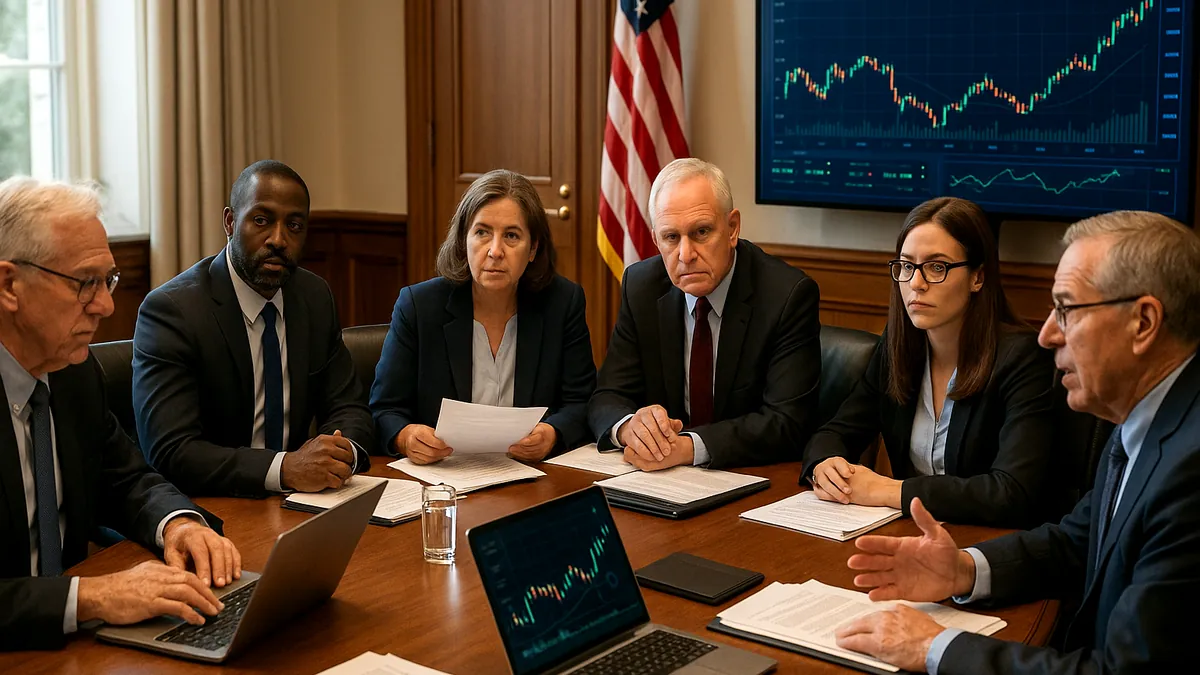
The stronger market signal is that major crypto legislation is still unresolved. Proposals tied to stablecoins and market structure, including the CLARITY Act, remain stalled in Congress, and the idea of a U.S. strategic Bitcoin reserve has not moved into settled policy.
That matters more than the personnel change because institutional adoption usually responds to rules, custody standards, issuer obligations, and enforcement boundaries, not to whether one adviser keeps a particular White House label. Sacks was involved in early efforts around the GENIUS Act and broader market structure pushes, but none of that substitutes for enacted law.
If Congress does not advance these bills, the U.S. crypto market is left with the same core friction: firms can read political interest, but they still cannot price regulatory certainty with much confidence. For liquidity and long-horizon capital, that distinction is material.
Why the White House crypto strategy still looks fragmented
The administration’s abandoned plan for a permanent White House crypto council is one of the clearer signs that the problem is not simply staffing. The council idea reportedly fell apart amid industry infighting, which suggests there was no durable internal and external consensus around how a federal crypto agenda should be organized.
The Bitcoin reserve debate shows a similar split. Questions over whether such a reserve should be funded with seized crypto assets or by drawing against gold reserves point to disagreements that are political, operational, and symbolic at the same time.
Those divisions matter because they limit the odds of a unified federal message. A market can absorb hard rules faster than it can absorb competing narratives about reserves, oversight, and strategic positioning.
What changed, what did not, and where the next signal sits
| Point | What it means | Market reading |
|---|---|---|
| Sacks left the crypto czar role | His 130-day legal term ended | Administrative change, not by itself a regulatory turning point |
| Sacks moved to PCAST | Influence continues, but across a wider technology agenda | Crypto may get less dedicated focus inside a broader policy portfolio |
| CLARITY Act and other market structure bills remain stalled | Congress has not delivered operating clarity | This is the main unresolved input for institutional positioning |
| Strategic Bitcoin reserve still unresolved | Internal disagreements persist over design and funding | Narrative-heavy topic until a concrete mechanism appears |
| Sacks sold more than $200 million in crypto assets on entering government | Conflict-of-interest concerns were taken seriously | Useful context, but not a substitute for policy follow-through |
One underappreciated point is that Sacks reportedly sold more than $200 million in crypto-related assets when he joined the administration to avoid conflicts of interest. That step reduced one obvious line of criticism, but it did not solve the larger issue that policy momentum still depends on legislation and institutional alignment.
The next checkpoint for investors and operators
The near-term test is straightforward: watch Congressional movement on the CLARITY Act and related market structure bills. If those proposals advance through committees, gain floor time, or begin to show cross-faction support, that would carry more weight than commentary around whether Sacks still speaks directly on crypto.
There is also a more cautious read on his move to PCAST. His recent public emphasis has leaned toward the administration’s AI framework rather than digital assets, which may mean crypto becomes one policy thread among several instead of a dedicated White House lane.
For market participants, that creates a simple filter. Treat Sacks’ departure as a signal about shifting administrative focus, but treat it as secondary to the legislative calendar; in U.S. crypto policy, the durable signal still comes from enacted market structure rules, not from a title change.
About the Author