Federal scrutiny of Bitmain has turned into a crypto market-structure issue because it sits where mining supply chains, national security review, and politically exposed capital now meet. The immediate question is not simply whether Bitmain machines are unsafe, or whether the Trump family is being used as a political target, but whether U.S. agencies will treat Chinese-made mining hardware as an actionable infrastructure risk when a major domestic buyer is tied to one of the country’s most visible political families.
How the case escalated from hardware review to political scrutiny
The underlying investigation is “Operation Red Sunset,” a Department of Homeland Security-led probe into whether Bitmain ASIC miners could be remotely manipulated for espionage or sabotage, including against parts of the U.S. power grid. The public still does not know what the investigation has concluded, which matters because miners, hosting operators, and equipment buyers are left to trade around rumor rather than formal findings.
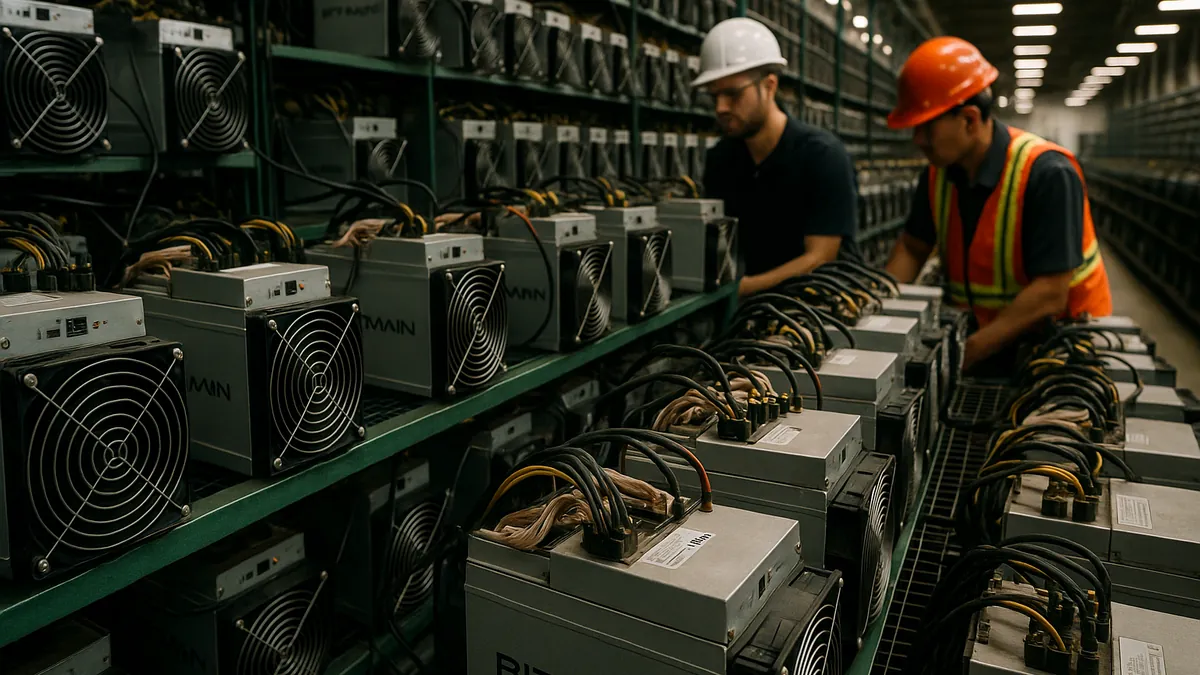
The political layer intensified after American Bitcoin, backed by Eric Trump and Donald Trump Jr., agreed to buy 16,000 Bitmain rigs for $314 million, paid in Bitcoin, with plans to operate 76,000 machines across the U.S. and Canada. That transaction shifted the story from a technical supply-chain review into a federal oversight question: whether agencies will apply the same standards when the buyer has unusually high-profile political connections.
Sen. Elizabeth Warren pushed that issue directly by seeking Commerce Department records involving Bitmain, American Bitcoin, and Trump family contacts. Her stated concern was not abstract optics but whether national security decisions could be softened, delayed, or selectively handled when a politically connected crypto operator is involved.
The factual markers that drove Washington’s concern

Federal concern over Bitmain predates the Trump family purchase. In May 2024, a federal review flagged a Bitmain-operated mining facility near Francis E. Warren Air Force Base in Wyoming as presenting “significant national security concerns,” showing that site location and proximity to sensitive assets had already become part of the government’s risk lens.
The concern hardened further in July 2025, when a Senate Intelligence Committee report described “several disturbing vulnerabilities” in Bitmain devices and tied the risk to China’s national security law. That is an important distinction for crypto investors: the issue being examined is not only whether a machine contains a software flaw, but whether legal and jurisdictional leverage could turn ordinary hardware dependence into a strategic vulnerability.
Commerce also blacklisted Bitmain AI affiliate Sophgo Technologies in 2025 over alleged ties to Huawei, while some Bitmain shipments were reportedly detained at U.S. ports for chip and software inspection. Those steps do not prove Bitmain mining hardware is compromised, but they do show the review is broadening beyond one company’s product claims into a wider U.S. policy response to Chinese-origin compute equipment.
What Bitmain and American Bitcoin say, and what that does not settle
Bitmain has denied wrongdoing, said it complies with U.S. law, and said it has no knowledge of “Operation Red Sunset.” American Bitcoin has separately said it performed extensive security testing and found no vulnerabilities that would permit remote access or create a credible threat to the U.S. grid.
Those statements matter, but they do not close the gap between private assurance and official determination. A mining company can test for known exploit paths and still be unable to answer the policy question U.S. agencies are asking, which includes how hardware, firmware, maintenance channels, chip provenance, and foreign legal obligations interact once large fleets are deployed near critical infrastructure or military-adjacent sites.
Where the real decision points are for miners, hosts, and investors
For the crypto market, the key signal is not the headline controversy by itself but whether the government moves from investigation to enforceable restriction. If agencies issue formal findings, require disclosures, limit placement near sensitive sites, or expand import controls, that would affect fleet valuations, hosting contracts, procurement timelines, and the resale market for Bitmain equipment across North America.
That is why this should not be read as a simple ethics fight in Washington. A politically connected buyer can intensify scrutiny, but the practical fallout lands in mining economics: financing terms may tighten for operators dependent on Bitmain supply, site diligence may expand beyond energy cost and uptime into geography and compliance, and buyers may pay a premium for alternative vendors if they believe policy risk is becoming part of machine pricing.
| Checkpoint | Why it matters | Market implication |
|---|---|---|
| Official disclosure from DHS, Commerce, or another federal body | Would separate evidence-based findings from open-ended suspicion | Could reprice Bitmain-dependent mining fleets and hosting exposure quickly |
| Restrictions tied to site proximity or infrastructure sensitivity | Would show the government sees location as part of the risk, not just the machines themselves | Could reduce viable hosting inventory near certain transmission or defense-linked areas |
| More import holds, firmware reviews, or component inspections | Signals scrutiny is operational, not merely political messaging | Procurement delays and higher working-capital needs for miners expanding capacity |
| Evidence that Trump family ties changed agency handling | Would shift the story from procurement risk to oversight integrity | Could trigger additional congressional and regulatory pressure on counterparties |
The next useful test is an official ruling, not another talking point
At this stage, the cleanest checkpoint is whether any federal agency publishes a ruling, enforcement action, or technical disclosure that clarifies if Bitmain hardware presents a provable and actionable security risk. Until that happens, participants should resist two bad shortcuts: treating every allegation as confirmed compromise, or dismissing the case as partisan noise because Trump-linked capital is involved.
The better reading is narrower and more useful. Bitmain sits at the center of a live U.S. review of Chinese crypto infrastructure hardware, and the Trump family’s American Bitcoin deal raises the stakes by testing whether political exposure changes how that review is conducted or communicated.
About the Author