
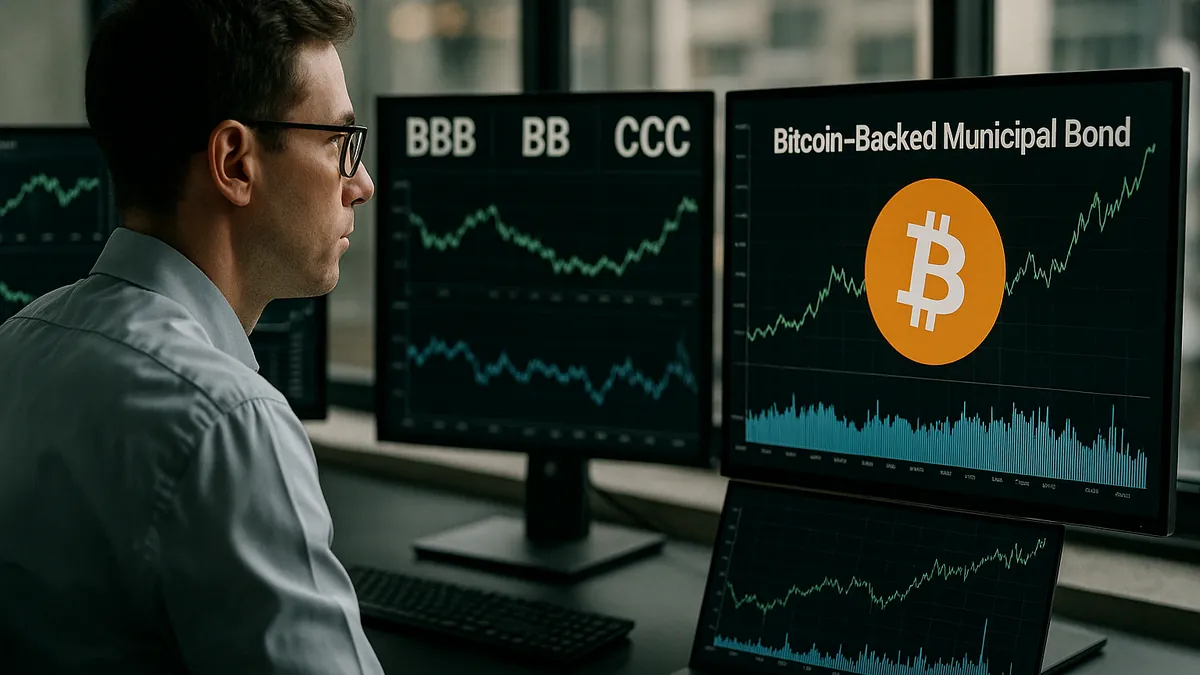
New Hampshire’s planned $100 million bitcoin-backed municipal bond matters less as a directional bet on BTC and more as a structured credit test: Moody’s has now put a Ba2 speculative-grade rating on a limited-recourse deal that relies on overcollateralized Bitcoin, automated liquidation rules, and no taxpayer support. That shifts the discussion from “is this a crypto gamble?” to whether regulated fixed-income markets will fund crypto collateral when the protections are explicit and the buyer base knows it is taking volatility risk.
Why Moody’s treated this as structured credit, not a simple muni
Moody’s Investors Service rated the transaction Ba2 because the repayment source is narrow and the collateral is highly volatile. The agency did not rate it as a conventional New Hampshire general obligation or revenue bond. Instead, bondholders are meant to be repaid from the liquidation of pledged Bitcoin, and Moody’s explicitly noted that no state or local public funds can be used to cover any shortfall.
That limited-recourse setup makes the deal look closer to conduit finance or project finance than to the municipal market’s safer core. The New Hampshire Business Finance Authority approved the structure in late 2025, but the authority is acting as a financing channel rather than a broad credit backstop. For crypto markets, that distinction matters: institutional acceptance here is arriving through ring-fenced legal structures and defined collateral waterfalls, not through governments directly taking Bitcoin onto their own balance sheets.
The protection package depends on math and execution
The core safeguard is overcollateralization of roughly 160%, meaning borrowers must post Bitcoin worth far more than the bond amount. If the Bitcoin value falls below a preset threshold, automated liquidation is supposed to sell enough collateral to make bondholders whole. BitGo is serving as custodian with the collateral held in regulated cold storage, while Wave Digital Assets is administering the transaction.
Moody’s stress testing used a 72% advance rate and short liquidation windows, which is a conservative way of asking whether the structure can survive fast price declines before losses outrun the collateral buffer. That is the real mechanism investors need to evaluate. In calm markets, the structure can look comfortably protected; in a sharp gap down, the operational chain has to work on time across valuation, trigger enforcement, execution, and settlement. The rating therefore reflects not just Bitcoin volatility in the abstract, but the narrower question of whether forced-sale protections remain effective under stressed market conditions.

What is signal and what is still only narrative
The signal is clear: a major ratings agency is willing to analyze a bitcoin-collateralized public-finance transaction inside a formal credit framework. That is a meaningful step for institutional market structure because it gives allocators something they can diligence through familiar tools such as collateral coverage, liquidation assumptions, custody controls, and legal recourse limits.
The narrative risk is overstating that step as mass adoption or as a public endorsement of Bitcoin itself. A Ba2 rating keeps the bond in speculative-grade territory, which narrows the likely buyer pool to high-yield credit funds, alternative managers, and crossover investors willing to underwrite both structured-credit mechanics and crypto volatility. Traditional investment-grade municipal buyers are not the natural audience here. The added twist is upside exposure to Bitcoin price appreciation, which could attract investors who would not normally buy municipal paper at all.
Where the market test starts
The next checkpoint is not another headline but the bond’s pricing and order book. Until there is a confirmed pricing date and actual demand, the key unknown is whether institutions want crypto-backed fixed income badly enough to accept speculative ratings, limited recourse, and dependence on automated collateral sales.
If the deal prices well, that would suggest there is real appetite for instruments sitting between digital assets and traditional credit. If demand is weak, the market may be saying that formal ratings and institutional custody are not enough to offset execution risk and Bitcoin volatility. Either outcome is useful because it turns an abstract debate about “institutional crypto adoption” into observable evidence on funding costs, buyer mix, and liquidity tolerance.
| Checkpoint | What is confirmed | What still needs proof in the market |
|---|---|---|
| Credit framing | Moody’s assigned a Ba2 speculative-grade rating | Whether investors accept the rating level for this kind of collateral |
| Collateral protection | About 160% overcollateralization and automated liquidation triggers | How the safeguards perform during fast BTC drawdowns and stressed liquidity |
| Operational stack | BitGo custody in regulated cold storage; Wave Digital Assets as administrator | Whether trigger execution, sale timing, and settlement work smoothly under pressure |
| Public finance risk | No taxpayer or state funds are liable | Whether the market prices that legal ring-fencing as sufficient protection |
| Investor demand | Potential appeal to high-yield, alternative, and crypto-adjacent buyers | Actual order-book depth, pricing level, and secondary liquidity |
Practical due diligence before treating this as a precedent
Anyone reading this as a template for future state issuance should slow down. The current deal is narrowly structured, speculative-grade, and dependent on a collateral management system that has to function during volatility spikes. A successful launch would not mean Bitcoin has become standard municipal collateral; it would mean one carefully boxed transaction found enough investors under specific protections and risk limits.
For market participants, the most useful lens is to separate legal isolation from economic safety. The absence of taxpayer exposure protects the state, not necessarily the buyer. Investors still need to ask whether liquidation thresholds are high enough, whether short liquidation windows are realistic in a fast market, and whether upside participation in Bitcoin compensates for the possibility that forced selling happens into a falling tape.
Governor Kelly Ayotte has endorsed the initiative as a way to attract investment without exposing taxpayers to risk. That political framing may help the deal reach market, but the real verdict will come from pricing discipline and post-issuance performance, not from the symbolism of being first.
Short Q&A
Is this New Hampshire buying Bitcoin with public money?
No. The structure is limited recourse, and Moody’s said no public funds from the state or its subdivisions can be used to cover bond losses.
Why is the rating only Ba2 if there is overcollateralization?
Because Bitcoin can move sharply, and the model still depends on liquidation happening fast enough to preserve value during stress.
What will show whether this is a real institutional step forward?
Final pricing, investor demand, and later evidence that the custody and liquidation framework works as designed.
About the Author