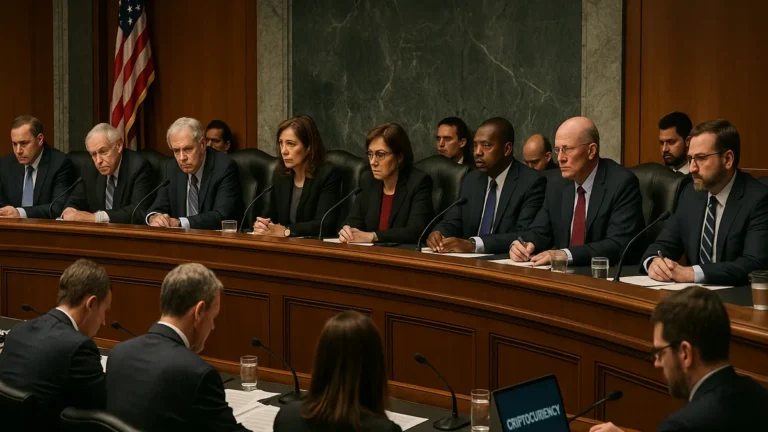
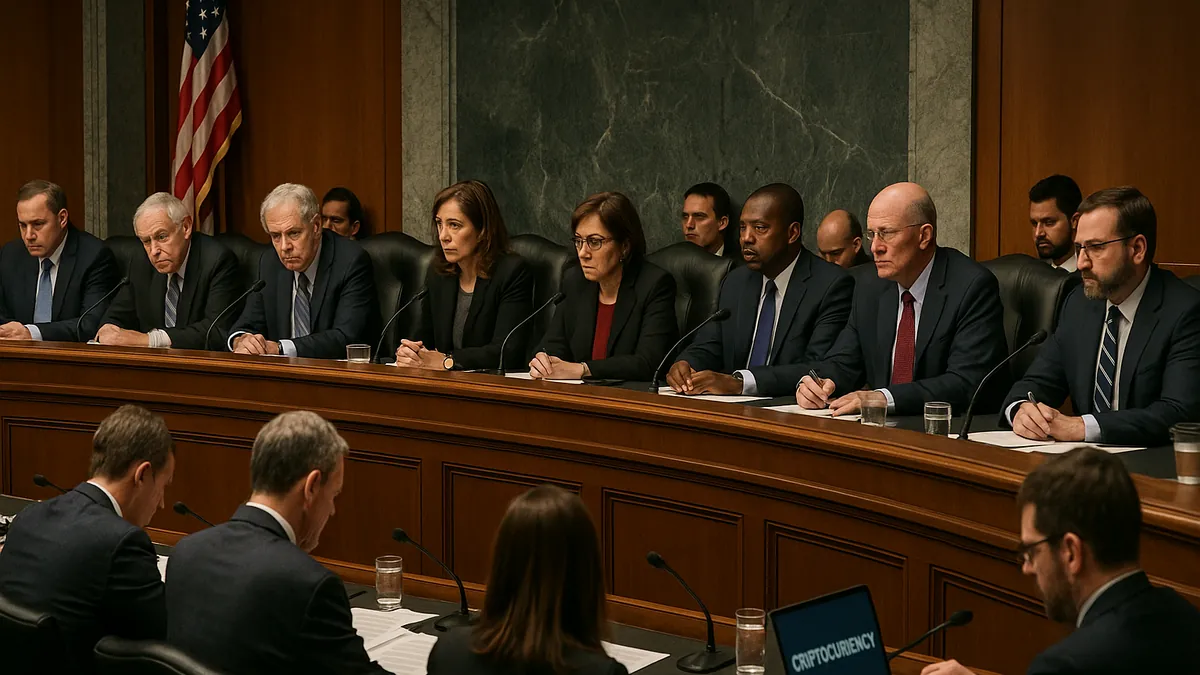
The strongest signal in the Senate Banking Committee’s CLARITY debate is not whether Washington wants to be tougher or friendlier toward crypto. It is whether lawmakers can settle the stablecoin yield dispute without breaking the bill’s larger balancing act between bank deposit protection, DeFi room to operate, and a workable market structure split between the SEC and CFTC.
Why the bill is stuck until April 2026
The Digital Asset Market CLARITY Act cleared the House in July 2025, but the Senate Banking Committee has delayed markup until at least April 2026. That delay matters because it compresses the calendar for committee revisions, floor time, and any reconciliation work, pushing realistic implementation toward 2027 or later if the bill survives at all.
The immediate obstacle is stablecoin yield. Banks want a ban because a yield-bearing stablecoin can look and function like an unregulated savings product that competes with federally insured deposits, while crypto firms argue that yield is part of stablecoin utility in payments and DeFi and should not be prohibited outright.
The market structure split the bill is trying to lock in

CLARITY is not written as a single-lane crypto bill. It divides assets into three buckets: digital commodities that would sit under CFTC oversight, investment contracts that remain under SEC jurisdiction during issuance and fundraising phases, and permitted payment stablecoins that would operate under a separate framework.
That design is meant to reduce one of the market’s biggest recurring frictions: not knowing which regulator owns which asset at which stage. But the bright line only works if the Senate can agree on what stablecoins are allowed to do, because the stablecoin lane becomes much less clear when the token also offers a yield feature that looks bank-like to one constituency and innovation-friendly to another.
DeFi protections are real, but they are not a free pass
The DeFi provisions are more precise than the usual “pro-crypto” or “anti-crypto” framing suggests. The bill protects software developers and peer-to-peer activity, while still requiring centralized intermediaries that use or route through DeFi protocols to meet risk management, cybersecurity, and compliance standards.
An amendment released in January 2026 sharpened that distinction by directing regulators to clarify registration and supervisory rules for protocol controllers and by requiring intermediaries to verify compliance and operational controls. That means the bill tries to preserve open protocol development at the edge while tightening obligations on companies that package DeFi exposure for customers in a more centralized business model.
Where the banking lobby and crypto firms are actually colliding
The core negotiation is not abstract ideology; it is product design and funding competition. Senator Angela Alsobrooks and others are working on compromise language that would block passive stablecoin yields viewed as too close to deposit-taking, while potentially allowing activity-based rewards that are tied to network use or specific participation rather than a simple interest-like return.
That distinction matters because it would decide whether the U.S. stablecoin market evolves mainly as a payments rail or also as a quasi-cash yield product. It also explains why some crypto stakeholders, including Coinbase, have pulled back support: from their perspective, a bill that clarifies jurisdiction but narrows token utility or pushes activity into more centralized channels may solve one regulatory problem by creating a structural market one.
| Issue | Current CLARITY direction | Why it is contested | Market consequence if unresolved |
|---|---|---|---|
| Asset classification | CFTC for digital commodities, SEC for investment contracts during issuance, separate lane for permitted payment stablecoins | Jurisdiction lines still need Senate agreement and implementing detail | Continued listing, issuance, and compliance uncertainty |
| Stablecoin yield | Still under negotiation, with compromise ideas around banning passive yield but allowing some activity-based rewards | Banks see deposit substitution risk; crypto firms see utility and competition | Markup delays, lower passage odds, and a narrower stablecoin design space |
| DeFi treatment | Developer and peer-to-peer protections, but compliance duties for centralized intermediaries using DeFi | Debate over where protocol neutrality ends and intermediary responsibility begins | Different compliance burdens across direct protocol use and wrapped access models |
| Illicit finance controls | AML, CIP, and CFT requirements for digital commodity brokers, kiosk registration, and transaction holds for law enforcement up to 30 days with possible extension | Industry concern over compliance load and surveillance scope versus national security priorities | Higher operating costs and tighter on- and off-ramp controls |
The next checkpoint is narrower than the headlines suggest
For readers trying to separate signal from narrative, the April 2026 Senate Banking Committee markup is the practical checkpoint, not the daily rhetoric around “crackdown” or “reform.” If lawmakers arrive with workable stablecoin yield language, CLARITY can still function as a negotiated market structure bill; if they do not, the rest of the framework becomes harder to advance even if there is broad agreement on classification and anti-illicit finance rules.
The anti-illicit finance side of the bill is already concrete: digital commodity brokers and exchanges would need AML, CIP, and CFT programs, digital asset kiosks would face registration requirements, and law enforcement could impose transaction holds of up to 30 days, with extensions in some cases. So the real legislative question is not whether the bill contains tough controls; it is whether the Senate can pair those controls with enough stablecoin and DeFi flexibility to keep both banking interests and crypto operators in the room.
About the Author