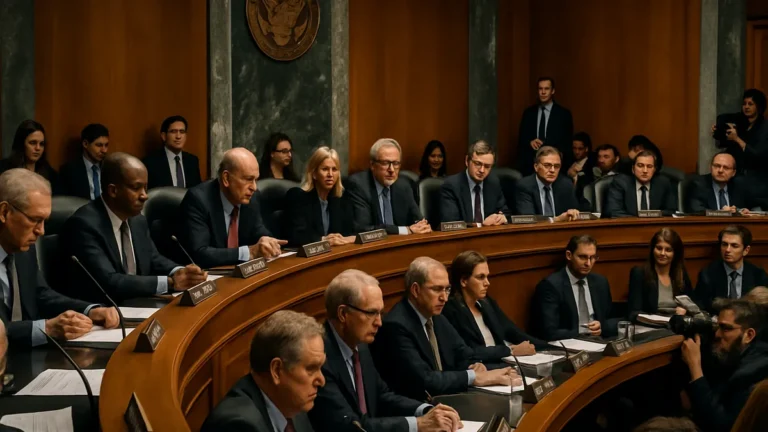
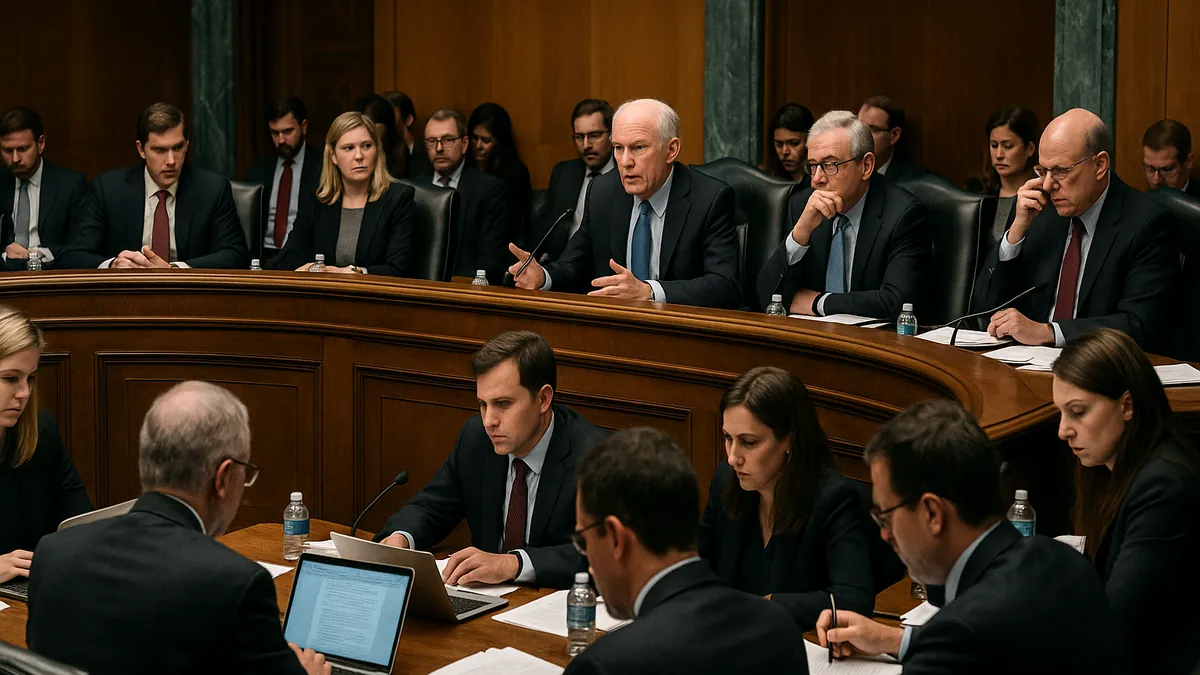
The CLARITY Act’s next phase in the Senate is not a straightforward pro-crypto or anti-crypto test. After passing the House on July 17, 2025, the bill has become a negotiation over market structure, bank funding risk, investor protections, and whether Congress can draw durable lines between the SEC and CFTC without freezing product innovation.
Why the Senate process is narrower than the House vote suggested
The immediate checkpoint is the Senate Banking Committee, which is working toward an April 3, 2026 target for advancement after earlier markup expectations slipped from January. That timing matters because the bill is no longer being judged only on whether the U.S. needs digital-asset legislation; it is being judged on which version of that framework can survive committee amendments and attract enough support to move beyond a hearing-stage consensus.
Senator Thom Tillis has become central to that process. Reports that he wants additional meetings with Coinbase and banking trade groups before deciding show where the real pressure sits: not on abstract support for crypto, but on whether the Senate can settle the terms of bank competition, stablecoin design, and agency jurisdiction in a way that does not create a new political liability a few months later.
The Senate draft changes the classification map
The House-passed bill tried to create clearer lines for digital-asset oversight, including a bright-line test meant to reduce the SEC’s regulation-by-enforcement approach. The Senate Banking Committee draft keeps the market-structure goal but changes the legal vocabulary by introducing “ancillary assets” alongside “digital commodities,” which is more than a wording tweak because category boundaries determine disclosure duties, registration burdens, and which regulator gets first authority.
The Senate version also requires a joint SEC-CFTC study on tokenization and directs the SEC to define “investment contracts” through rulemaking within two years. That combination matters for market participants because it signals that Congress is not only reallocating jurisdiction today; it is also forcing a future process for how tokenized securities, hybrid assets, and issuance structures may be treated after the bill passes.

Other Senate draft features, including stronger protection for software developers and clearer bankruptcy treatment for digital assets, point to a more operational version of market-structure legislation. For traders, issuers, and infrastructure firms, that is a reminder that the bill is not just about agency turf; it also affects recoveries in insolvency, developer liability, and the compliance perimeter for centralized intermediaries versus peer-to-peer or decentralized activity.
Stablecoin yield is where the coalition can break
The biggest flashpoint remains stablecoin yield products. Banks argue that if regulated stablecoins can easily offer yield-like returns, deposits may migrate out of the banking system, raising funding pressure and creating a policy mismatch in which bank-like products compete without bank-style supervision.
Crypto advocates argue the opposite risk is being overstated: if regulated yield access is banned or heavily constrained, users will continue to seek returns through less transparent offshore venues or improvised onchain structures. In that reading, the issue is not whether yield exists, but whether U.S. law allows it to exist inside a supervised framework with disclosure, reserve, and conduct rules.
This is the dispute that best explains why the CLARITY Act should not be read as a clean industry victory or a hidden crackdown. It is a balancing exercise between two different liquidity systems: bank deposits that support traditional lending and payments, and tokenized dollar instruments that can move faster across crypto markets and potentially absorb capital that would otherwise remain in bank accounts. That is why banking groups are resisting yield provisions so intensely, and why crypto firms see them as central rather than peripheral.
What actually changes if the bill advances
| Checkpoint | If resolved in markup | If left unresolved |
|---|---|---|
| Jurisdiction definitions | Firms get a clearer path on whether assets fall under SEC or CFTC oversight, improving listing, issuance, and compliance planning. | Classification risk stays high, and market participants remain exposed to uneven enforcement and delayed product launches. |
| Stablecoin yield rules | The bill could create a controlled channel for yield products or set clear prohibitions that markets can price around. | Banks and crypto firms keep lobbying against each other, increasing amendment risk and slowing final passage. |
| SEC rulemaking on investment contracts | The SEC would have a statutory deadline to move from enforcement toward formal definitions. | Congress leaves the core definitional dispute partly intact, weakening the bill’s promise of clarity. |
| Fallback if the bill stalls | Congress sets the framework, giving markets a more durable basis for capital allocation and infrastructure buildout. | SEC Chair Paul Atkins and CFTC Chair Mike Selig may still push agency-led frameworks, but without the permanence of statute. |
For crypto markets, the practical distinction is between legislation that reduces structural uncertainty and regulation that remains reversible with leadership changes. Agency action can still move custody, disclosures, and trading oversight, but it does not solve the same long-duration questions for token issuance, exchange architecture, or institutional capital commitments.
The right decision lens before the markup
If you are treating the bill as a directional signal for crypto prices alone, you are probably looking at the wrong variable. The stronger signal is whether the Senate can produce language that banks can tolerate, crypto firms can use, and regulators can administer without reopening the same classification fight every quarter.
The next useful watchpoints are specific: the Senate Banking Committee’s markup outcome, any amendment aimed at stablecoin yield restrictions or permissions, whether the Senate keeps or narrows the “ancillary assets” concept, and Senator Tillis’s final position after his requested meetings. Those are the conditions that determine whether the CLARITY Act becomes workable market structure or another narrative that sounds decisive before the hard definitions are written.
Short reader questions
Does House passage mean the bill is likely to become law?
Not by itself. The Senate draft differs on core definitions, and the Banking Committee markup is where those differences can either be narrowed or become a bigger obstacle.
Why are stablecoin yield products receiving so much attention?
Because they touch both crypto utility and bank funding. They are one of the few issues in the bill that directly affect who holds dollar liquidity and under what regulatory model.
What is the main sign that the bill is improving rather than stalling?
A committee outcome that clarifies jurisdiction and addresses yield without leaving those questions for later fights between agencies, banks, and issuers.
About the Author