
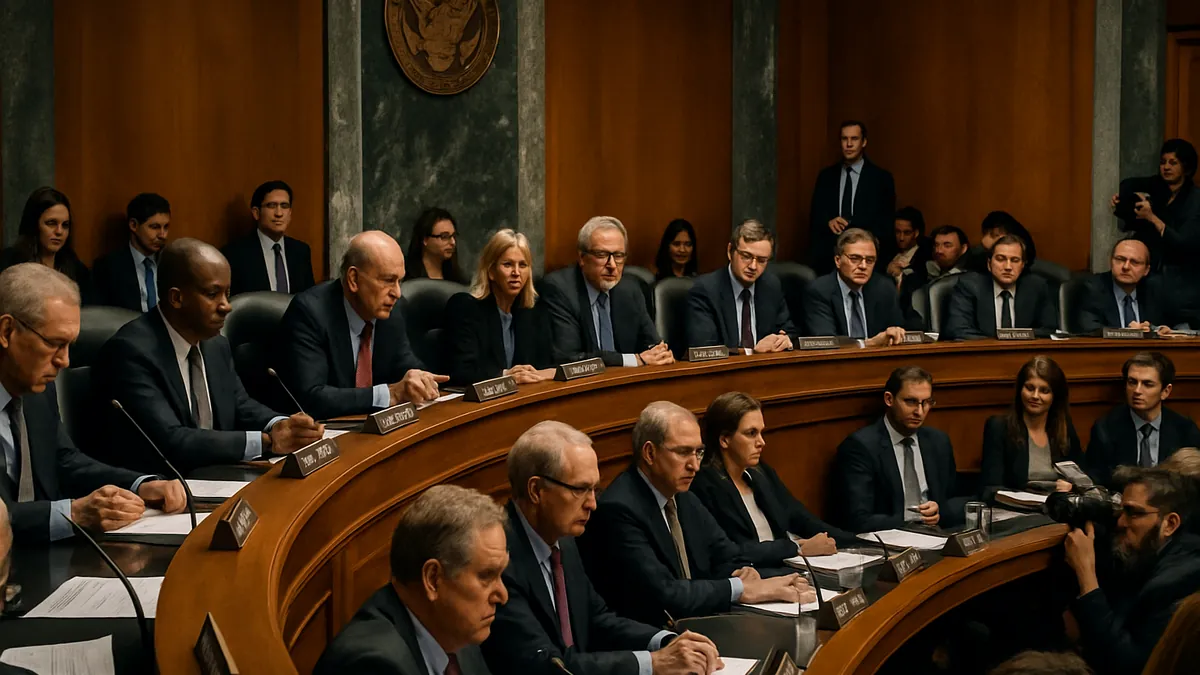
The Senate Banking Committee’s May 14 markup of the CLARITY Act is not a simple up-or-down moment for “crypto regulation.” It is a second attempt after January’s cancellation, and the real signal is whether lawmakers can hold together a narrow compromise on stablecoin rewards, market-structure jurisdiction, DeFi boundaries, and political ethics without losing either industry support or bipartisan votes.
The second try hinges on a narrower stablecoin deal
The immediate dispute is often misread as a ban on stablecoin yield. It is narrower than that: the Tillis-Alsobrooks compromise would block passive interest paid merely for holding a stablecoin, while still allowing activity-based rewards tied to transactions or platform use.
That distinction matters because it is what brought Coinbase back from the brink after stablecoin language helped sink the January attempt. It also explains why banking groups still object: from their perspective, even non-passive incentives could make dollar-backed tokens more competitive with bank deposits, especially if platforms can package transaction rewards in ways that feel economically close to yield.
Jurisdiction is the market-structure core of the bill
Beyond stablecoins, the CLARITY Act would move major digital assets such as Bitcoin and Ethereum out of the SEC’s enforcement orbit and into a wider CFTC framework for digital commodities. In practical terms, that is the bill’s biggest structural change, because it would reset who writes rules, who supervises trading venues, and how token classification fights are handled going forward.
The timing is not abstract. U.S. spot Bitcoin ETFs now sit on nearly $100 billion in assets, and those products depend on Bitcoin being treated as a commodity with durable regulatory footing. A statutory shift that confirms CFTC jurisdiction would support that institutional setup, but it also creates a capacity problem: the CFTC would need materially more funding and staffing if Congress expects it to oversee a much larger slice of the crypto market.

DeFi gets carve-outs at the protocol layer, not at the interface
The bill does not treat all decentralized finance activity the same way. Core infrastructure functions such as mining, staking, and validation are exempt from registration, which is meant to protect protocol-level operations from being regulated as if they were traditional intermediaries.
That protection stops at the access layer. Custody providers, front-end platforms, and other centralized businesses that connect users to DeFi protocols would still face regulatory duties, including risk-management and cybersecurity requirements. For projects and investors, that means the practical compliance burden may land less on code and more on the companies that package, distribute, and monetize access to that code.
Industry support is split because the trade-offs are real
Chairman Tim Scott is trying to get Republicans aligned before the committee vote, but the coalition around the bill remains fragile. Coinbase CEO Brian Armstrong had previously withdrawn support over stablecoin language, privacy concerns, market-structure issues, and provisions he argued could weaken the CFTC relative to the SEC, while Kraken co-CEO Arjun Sethi has continued to back the legislation as preferable to ongoing regulatory uncertainty.
That split is useful as a reading tool. The market should not treat “industry support” as a single signal, because exchanges, stablecoin issuers, banks, DeFi builders, and ETF-linked institutions are exposed to different parts of the bill. The projects most sensitive to reward design care about the yield language; ETF issuers and large allocators care more about commodity classification and SEC-CFTC boundaries; DeFi-adjacent businesses have to focus on whether they are treated as infrastructure or as regulated interfaces.
| Issue | Current CLARITY direction | Who gains or loses | What to verify on May 14 |
|---|---|---|---|
| Stablecoin rewards | Passive yield banned; activity-based rewards allowed | Helps some crypto platforms; worries banks protecting deposit franchises | Whether the compromise survives amendments without reverting to a blanket restriction |
| Asset jurisdiction | Major digital commodities shift toward CFTC oversight | Supports exchanges and ETF markets seeking clearer classification; pressures CFTC resources | Whether funding and authority expansion move together |
| DeFi treatment | Protocol infrastructure exempt; centralized interfaces regulated | Protects core network activity but raises compliance costs for access businesses | How clearly the bill defines intermediaries, front ends, and custody obligations |
| Ethics rules | Still contested; Democrats want limits on politicians profiting from digital assets | Could decide bipartisan support more than any technical crypto clause | Whether committee amendments add ethics language or push the fight to later stages |
The amendment fight may matter more than the vote count
The most politically sensitive unresolved issue is the ethics language. Democrats want provisions that would bar elected officials, including President Trump and members of Congress, from profiting from digital assets, while Republicans have resisted folding that issue into the market-structure bill. Because the committee only needs a simple majority to advance the measure, passage alone would not settle whether the coalition is stable enough for the full Senate, where 60 votes remain the real threshold.
The next verified checkpoint is therefore narrower than “does the bill pass committee.” Watch whether the Senate Banking Committee advances CLARITY with bipartisan amendments that address ethics and banking concerns, and then whether the Senate version can be reconciled with the House approach without reopening the same stablecoin and jurisdiction fights.
Short Q&A
Is CLARITY banning all stablecoin rewards?
No. The current compromise bans passive interest for simply holding a stablecoin but still allows rewards tied to transactions or platform activity.
Why does the SEC-CFTC shift matter for markets now?
It affects classification certainty for large assets such as Bitcoin and Ethereum, which matters directly for exchanges, enforcement risk, and the legal footing of spot ETF products.
What is the clearest warning sign on May 14?
If lawmakers cannot preserve the yield compromise or cannot bridge the ethics dispute, the bill can advance in a weakened form or stall again despite headline progress.
What should readers track after committee?
Whether CFTC authority comes with funding, whether the House and Senate versions align, and whether bipartisan support survives the move from committee markup to a 60-vote Senate floor process.
About the Author