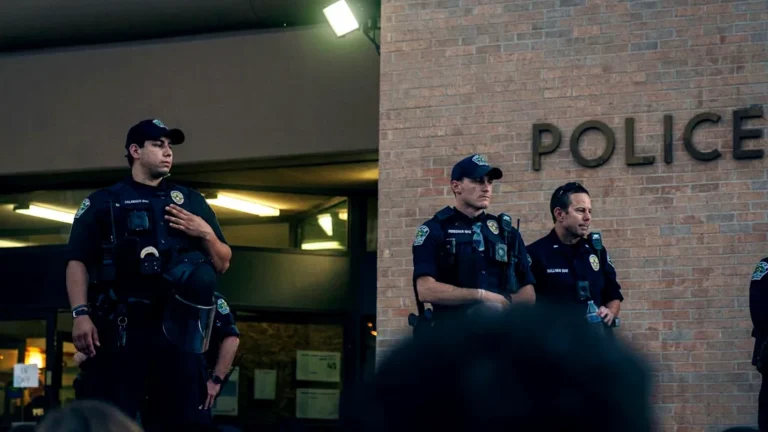
Federal sentences for former Los Angeles County Sheriff’s Department deputies Scott Allen Simpkins and Michael David Coberg make one point hard to ignore: Adam Iza’s crypto-linked crimes were not enforced by a few rogue off-duty officers drifting into bad decisions, but by a coordinated protection and intimidation network that used law-enforcement status as an operational tool.
Why the deputy cases matter to the Iza file
Simpkins was sentenced to 18 months in federal prison after admitting he lied to investigators about a 2021 extortion at Iza’s Bel Air mansion. Prosecutors said Iza forced a party planner to transfer $25,000 while brandishing live 9mm rounds, and that Simpkins and former deputy Christopher Michael Cadman escorted the victim off the property. That matters because the case is not limited to passive presence at a bad scene; Simpkins’ conviction shows federal prosecutors treated concealment of the event as part of the criminal structure around Iza.
The payment arrangement also cuts against the idea of incidental off-duty work. Simpkins and Cadman were paid $1,400 per shift and received 10% of their security firm’s first-month profits from Iza’s contract. Prosecutors further described a wider pattern in which Iza allegedly paid LASD deputies tens to hundreds of thousands of dollars per month for personal enforcement and intimidation services. In crypto terms, that is not background color. It is the coercive infrastructure that helped a fraud operator preserve control, collect money, and pressure targets outside normal legal channels.
Coberg’s sentence shows where security became criminal partnership
Michael David Coberg received 63 months, far above Simpkins’ term, because his role went beyond obstruction or presence. Federal prosecutors said Coberg acted as Iza’s business partner and advisor, was paid at least $20,000 a month, and helped execute extortion directly. One incident involved coercing a rival businessman into transferring $127,000 under armed threat at Iza’s residence.

The most important escalation came in September 2021, when Coberg orchestrated a false arrest scheme against another Iza adversary. According to prosecutors, Coberg and other corrupt deputies, including Cadman, lured the victim from Miami to Los Angeles, used the victim’s ex-girlfriend as bait, staged a traffic stop, and pushed fabricated drug charges. Coberg reportedly misled fellow deputies by inventing a confidential-informant basis for the operation. That changes the decision lens for readers following crypto enforcement risk: the case is not about a fraudster hiring muscle, but about a fraudster allegedly converting parts of law enforcement into an extension of his private dispute-resolution system.
What the criminal stack around Adam Iza actually looks like
Iza’s own guilty pleas connect the deputy cases to a larger enterprise rather than to one mansion incident. Since his September 2024 arrest, he has pleaded guilty in California to conspiracy, wire fraud, and tax evasion tied to a $37 million phishing scheme run through a platform called Zort. Separately, in Connecticut, he pleaded guilty to conspiracy to interfere with commerce in connection with an attempted Bitcoin robbery and kidnapping case in Danbury involving the victim’s family.
That combination matters because it shows different layers of criminal activity feeding each other. The fraud side generated money. The deputy network, as alleged by prosecutors, supplied intimidation, extortion capacity, and false-arrest leverage. The Connecticut Bitcoin case shows that violence and coercion were not confined to one local dispute or one business conflict in Los Angeles. For anyone trying to separate signal from narrative, the durable signal here is structural: when crypto-related proceeds are paired with access to compromised law-enforcement actors, the operational risk expands from financial loss to physical coercion and evidence manipulation.
Sentencing map: who enabled what, and what still needs to be resolved
| Person | Role described by prosecutors | Key conduct | Status / sentence |
|---|---|---|---|
| Scott Allen Simpkins | Former LASD deputy; security for Iza | Lied about witnessing the 2021 Bel Air $25,000 extortion | Sentenced to 18 months |
| Michael David Coberg | Former LASD deputy and helicopter pilot; partner/advisor to Iza | Extortion, false-arrest conspiracy, coordination of staged drug charges | Sentenced to 63 months |
| Christopher Michael Cadman | Former LASD deputy; security for Iza | Linked to Bel Air extortion and false-arrest scheme | Sentencing pending |
| Adam Iza | Crypto-linked fraud defendant | Guilty pleas covering conspiracy, wire fraud, tax evasion, and Connecticut Bitcoin kidnapping-related conspiracy | Final sentencing pending |
The spread between 18 months and 63 months already gives a working guide to how the court is distinguishing roles: lying to shield the enterprise is one tier; helping run extortion and weaponize arrests is another. The next real checkpoint is Cadman’s sentencing, followed by Iza’s final sentencing. Those outcomes should clarify whether prosecutors and the court view this primarily as a fraud case with corrupt side actors, or as a deeper corruption-and-extortion network built around crypto proceeds.
Practical reading for crypto risk and enforcement watchers
If you follow crypto through the lens of market structure and regulation, this case fits less into token analysis and more into counterparty and enforcement risk. The useful signal is that criminal enterprises around crypto can depend on off-chain power: personal security, local influence, false legal pressure, and compromised officials. That can distort victim reporting, delay investigations, and make headline losses look smaller than the full coercion system behind them.
For compliance teams, investigators, and institutional readers, the warning sign is not merely a founder or operator with fraud allegations. It is the combination of unexplained security spending, ties to former law-enforcement personnel, intimidation of counterparties, and disputes that migrate from civil or commercial settings into staged criminal accusations. Those are indicators of a network trying to buy enforcement capacity rather than legal defense.
Short Q&A
Is the key development the prison terms themselves? Partly, but the larger value is what the sentences confirm about structure: multiple former deputies were not orbiting Iza separately, they were tied into the same enforcement pattern.
What should readers watch next? Cadman’s sentencing and Adam Iza’s final sentencing are the clearest next checkpoints for measuring how fully the courts map the network.
Why does this belong on a crypto radar? Because Iza’s admitted conduct includes a $37 million phishing scheme and a separate Bitcoin kidnapping-related conspiracy, and the deputy network appears to have helped protect or extend that criminal enterprise.
About the Author