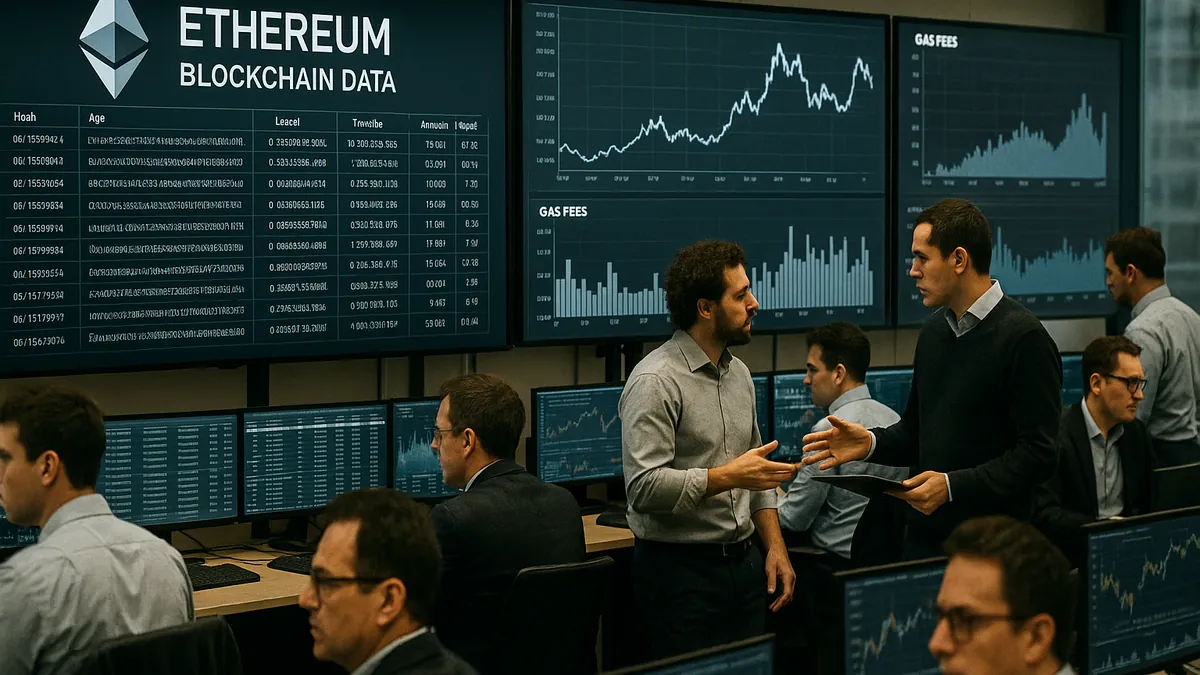
ETHGas’s launch matters because it changes how Ethereum blockspace is priced and sold. Instead of treating gas as a last-second auction with unstable fees, the protocol is building a liquid market where validators can sell execution commitments up to 64 blocks, or about 12.8 minutes, in advance, giving traders, dApps, and institutions a way to lock in timing and cost before they submit transactions.
From spot gas auction to scheduled inventory
That distinction is the core correction. ETHGas is not mainly a speed patch and it is not a Layer 2 that moves demand away from Ethereum. Its model keeps activity on Ethereum while restructuring blockspace into standardized products that can be bought, sold, and potentially hedged like other scarce market resources. The change is about market structure: turning a volatile fee environment into something closer to forward supply.
The products are concrete. Validators can sell whole block commitments, inclusion guarantees, and eventually execution guarantees. A whole block commitment gives a buyer rights to the block’s full gas capacity and transaction ordering. An inclusion guarantee reserves placement in a specific block up to a gas limit. Execution guarantees, still in development, go a step further by promising a defined on-chain outcome rather than only access to blockspace. Because these commitments can support secondary trading, participants are not locked into a one-shot decision; they can resell exposure and manage timing risk as conditions change.
Why validator alignment matters more than the headline speed claims

ETHGas says the marketplace is backed by $800 million in liquidity commitments from validators and ecosystem participants. In crypto market terms, that figure matters less as a branding number than as evidence that the supply side is willing to participate. A blockspace market only works if validators and builders treat future capacity as inventory they are prepared to pre-sell, and if buyers believe those commitments will be honored under live conditions.
The protocol is designed to sit alongside Ethereum’s proposer-builder separation setup rather than replace block production. That lowers adoption friction because validators and builders do not need a new chain or a separate execution venue to monetize blockspace differently. It also changes staking economics: instead of earning only whatever the spot fee market happens to offer at the moment of block production, validators can capture a certainty premium by selling predictable access in advance. For institutions and treasury desks, that is the more important signal than general talk about innovation, because it suggests ETHGas is trying to create a repeatable liquidity loop rather than a one-off product launch.
What ETHGas is actually selling
The easiest way to read the platform is as a set of distinct execution promises, each with a different buyer and risk profile.
| Product | What the buyer gets | Primary use case | Main constraint |
|---|---|---|---|
| Whole block commitment | Exclusive access to a full block’s gas capacity and ordering rights | Large traders, searchers, or applications that need complete control over sequencing | Highest capital requirement and strongest reliance on fulfillment quality |
| Inclusion guarantee | Transaction placement in a specified block up to a gas limit | dApps, wallets, and traders that need timing predictability without full block control | Does not guarantee a full execution outcome beyond placement |
| Execution guarantee | A promised on-chain result, not just reserved space | Complex transactions where outcome certainty matters more than mere inclusion | Still under development, so delivery risk is not yet fully tested |
This product ladder is why ETHGas fits the crypto market structure category better than the “faster Ethereum” framing. Different users are buying different forms of certainty, and the pricing of those guarantees can reveal more than headline gas averages do. If the market deepens, the useful signal will be whether forward pricing becomes reliable enough for applications and funds to build workflows around it, not whether a short-term announcement drives token attention.
Real-time sequencing, $GWEI, and the user-experience layer
ETHGas also says it is introducing real-time sequencing that slices blocks into 50 to 100 millisecond intervals. The goal is to make Ethereum feel 100x to 200x faster in responsiveness while reducing extractable MEV by narrowing the window in which opportunistic reordering can occur. That feature matters, but it should be read as an extension of the blockspace market thesis rather than a separate story. Faster perceived execution is valuable because pre-sold and guaranteed blockspace becomes more useful when users can act on near-instant feedback.
The governance and application layers are built around the same idea of making gas predictable. The ETHGas Foundation uses the $GWEI token for staking, voting, and protocol upgrades, with reported tokenomics including 31% for the ecosystem, 27% for investors, and 22% for the team. Separately, the Open Gas Initiative lets dApps sponsor or rebate gas fees so users do not have to manage every transaction cost directly. For consumer-facing apps, that is a practical shift: instead of asking users to tolerate fee uncertainty at the point of action, developers can treat gas more like a managed operating expense.
Adoption tests that will separate signal from narrative
The next real checkpoint is not whether ETHGas can describe a new market design, but whether its real-time sequencing and execution guarantee products work under normal and stressed usage. Those are the pieces that would prove the marketplace can deliver near-instant, predictable execution rather than just list tradable claims. Without that proof, the project remains closer to an interesting pricing layer than a fully trusted execution venue.
There is also a policy and concentration question to watch as the market matures. If blockspace futures, preconfirmations, and centralized matching mechanisms attract traditional finance firms, sovereign funds, and digital asset treasury managers, regulators may pay closer attention to how these commitments are marketed and settled. At the same time, deeper liquidity could improve price discovery while still concentrating influence among large validators, builders, and well-capitalized buyers. For now, the most useful lens is simple: ETHGas is trying to make Ethereum blockspace behave like a financial market, and the decisive evidence will be fulfillment quality, secondary liquidity, and whether applications actually start buying certainty instead of simply paying spot gas.
About the Author