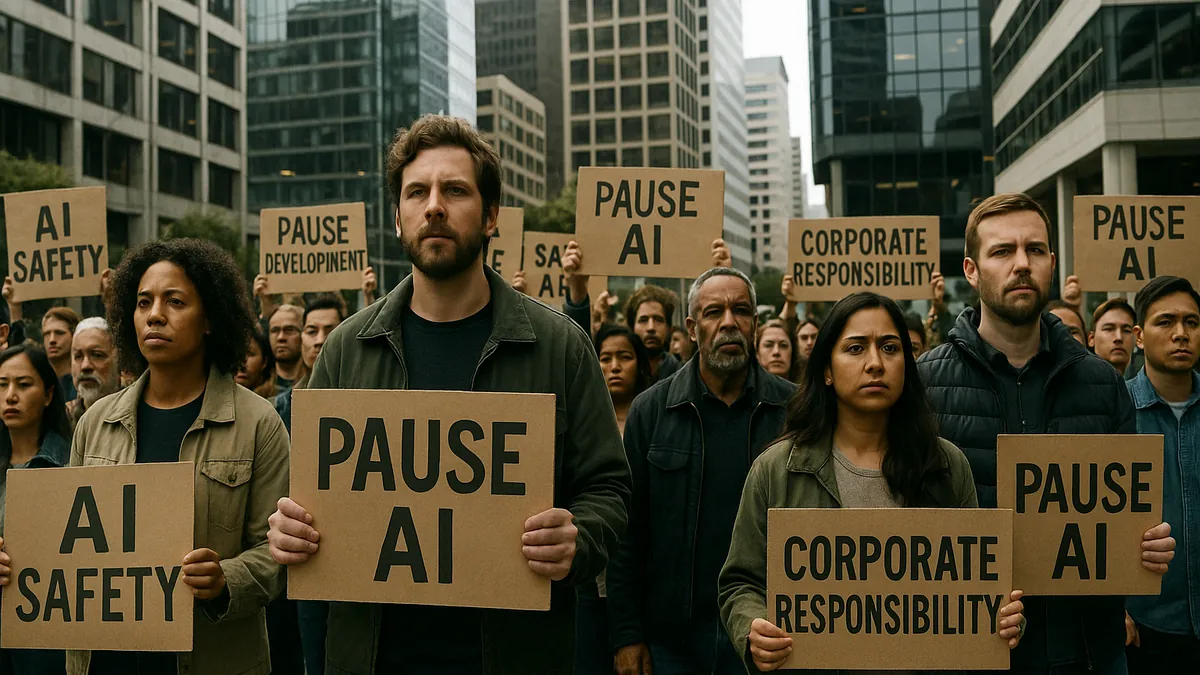
The March 21 protest in San Francisco was not just another public warning about AI risk. It tied a specific demand for a coordinated pause in frontier model development to two concrete pressure points: defense contracting and a U.S. policy framework that would centralize AI rules in Washington while limiting company liability.
March 21 put a conditional pause demand directly on three CEOs
Dozens of protesters organized by Stop the AI Race gathered outside the San Francisco offices of Anthropic, OpenAI, and xAI on March 21, 2026. Their ask was narrow enough to test in public: Dario Amodei, Sam Altman, and Elon Musk should each commit to pausing frontier AI development if all major labs agree to do the same. That condition matters because the group is not asking one company to unilaterally disarm while rivals continue scaling.
The route itself carried the message. Marchers started at Anthropic, moved to OpenAI and xAI, and ended at Dolores Park, keeping the focus on the dense cluster of firms driving the current frontier model race. Organizers framed the issue around existential risk and recursive self-improvement, but the event was anchored in present-day company behavior rather than abstract speculation.
Washington’s framework changes who can set the rules
The protest came after the White House released a national AI legislative framework under the Trump administration. As described by critics and supporters, the framework would block states from creating their own AI laws and would limit AI company liability with protections compared to Section 230 for social media platforms. For market structure, that is a major shift: it would move the center of regulatory leverage away from statehouses such as California and toward federal policy design and enforcement.
That helps explain why the San Francisco activism is not just a local story. California State Senator Scott Wiener has argued that the federal approach favors innovation over stronger safety controls, while cybersecurity and policy commentator Ahmed Banafa has warned about reduced accountability if liability is narrowed too far. In practical terms, a preemptive federal regime could make it harder for states to impose tighter deployment rules even when the largest labs, talent pools, and enterprise customers are concentrated there.
Pentagon contracts turned safety rhetoric into a live governance dispute
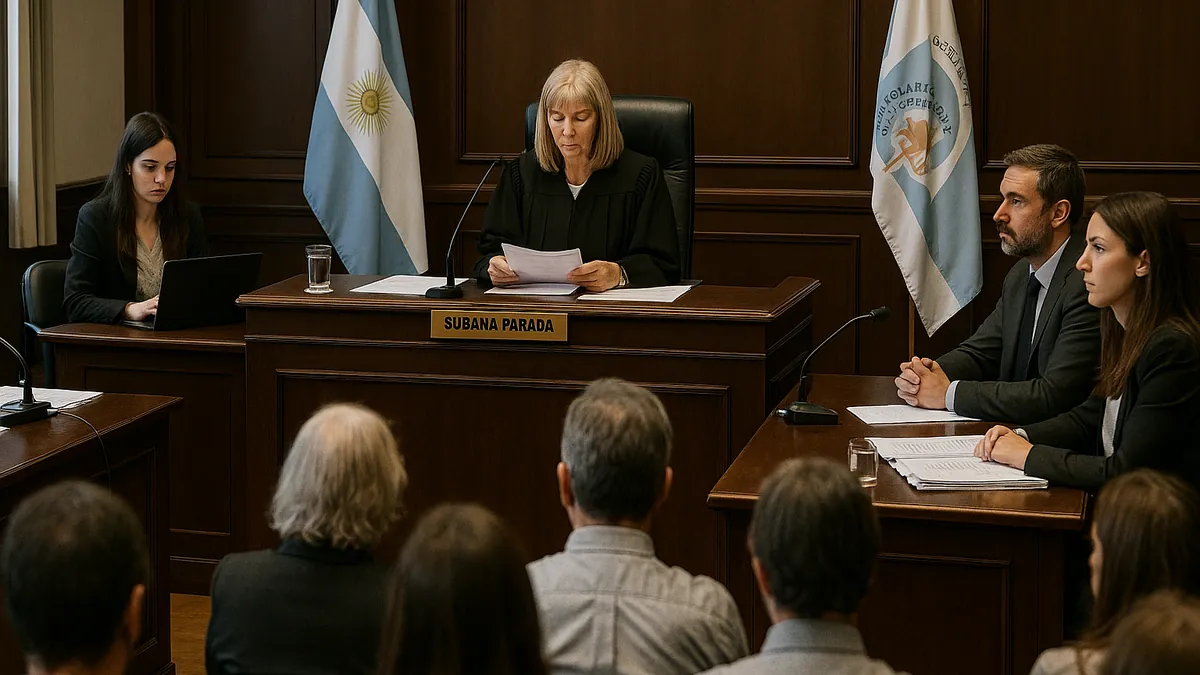
The sharpest conflict is around military use. OpenAI’s Pentagon contract prompted protests, including the QuitGPT actions in San Francisco, because opponents believe frontier systems could be routed into autonomous weapons or mass surveillance. That concern is not a generic anti-tech slogan; it is tied to an identifiable contract pathway and a named buyer.
Anthropic sharpened the contrast by refusing similar Pentagon contract terms that would have allowed those kinds of applications. At the same time, the company is challenging its designation as a “supply chain risk,” a label that affects eligibility for federal contracts. That legal fight matters because it shows how AI safety positioning, procurement access, and national security screening are starting to interact. In other words, the debate is no longer only about model capability or training pace; it is also about which firms can win government demand and on what conditions.
That distinction is useful for separating signal from narrative. The real signal is the combination of contract language, federal eligibility, and liability design. The narrative is the idea that all concern about AI risk is just generalized fearmongering. The current dispute is grounded in named contracts, procurement status, and a proposed legal framework.
Who is backing the pause, and what has not happened yet
Support for the conditional pause has come from identifiable AI safety figures, including David Krueger and Nate Soares of the Machine Intelligence Research Institute, who have described it as an emergency measure rather than a symbolic protest slogan. The campaign also builds on earlier actions such as the 2025 Google DeepMind hunger strike and the 2026 PauseAI demonstration in London, suggesting a developing activist network rather than a one-off street action.
But the immediate gap is still at the company level. Anthropic, OpenAI, and xAI had not publicly accepted the March 21 demand. That silence matters more than broad public sentiment because the proposal only works if major labs coordinate. It also arrives as OpenAI continues restructuring toward a for-profit model and faces criticism that some safety commitments have weakened, while firms in China including Alibaba, Baidu, and Tencent continue pushing AI deployment. Those cross-currents make a pause harder to execute even if some researchers support it in principle.
The next checkpoint is public commitment versus federal lock-in
For readers trying to judge whether this story is moving from activism into policy consequence, the next checkpoints are concrete. First, watch for any public statement from Sam Altman, Dario Amodei, or Elon Musk on the conditional pause itself rather than general safety language. Second, track whether Congress or a future administration keeps, rewrites, or abandons the Trump-era approach to state preemption and liability protection.
If those two tracks do not move, the protest remains a pressure campaign. If either one shifts, especially around federal procurement rules or liability shields, the balance of power around frontier AI governance changes quickly.
Short Q&A
Is the protest mainly about long-term existential risk?
Not only. The organizers use that argument, but the current dispute is also tied to Pentagon contracts, surveillance concerns, and a federal framework that could narrow state oversight.
Why does the conditional part of the pause matter?
Because the demand is for a coordinated halt only if all major labs agree, which addresses the competitive argument that one firm cannot stop while others keep training.
What is the clearest near-term signal to watch?
A direct public response from Anthropic, OpenAI, or xAI on the pause demand, plus any legislative move in Washington on liability limits or federal preemption of state AI laws.
About the Author