Riot Platforms’ sale of 3,778 Bitcoin in Q1 2026 looks significant because it was larger than the quarter’s production, but the stronger signal is where the cash is going. The company raised $289.5 million at an average price of $76,626 per Bitcoin and framed the move as treasury management tied to capital spending, especially its push into AI and high-performance computing infrastructure.
Why the sales stand out this quarter
Riot mined 1,473 BTC in Q1, down 4% from a year earlier, yet sold more than 2.5 times that amount. That is a clear break from the company’s earlier pattern of leaning more heavily on holding mined Bitcoin on the balance sheet.
The treasury change is also visible in Riot’s holdings. Total Bitcoin reserves fell 18% year over year to 15,680 BTC from 19,223 BTC, and 5,802 of those coins were restricted, which limits how much of the remaining treasury is immediately available for sale or financing.
That distinction matters for interpretation. A miner can reduce holdings because it is under pressure, or because it is deliberately converting a volatile asset into project funding; in Riot’s case, the stated use of proceeds points to the second category, with Corsicana, Texas and related AI data center buildout central to the story.
Operations did not deteriorate in the same way the treasury did
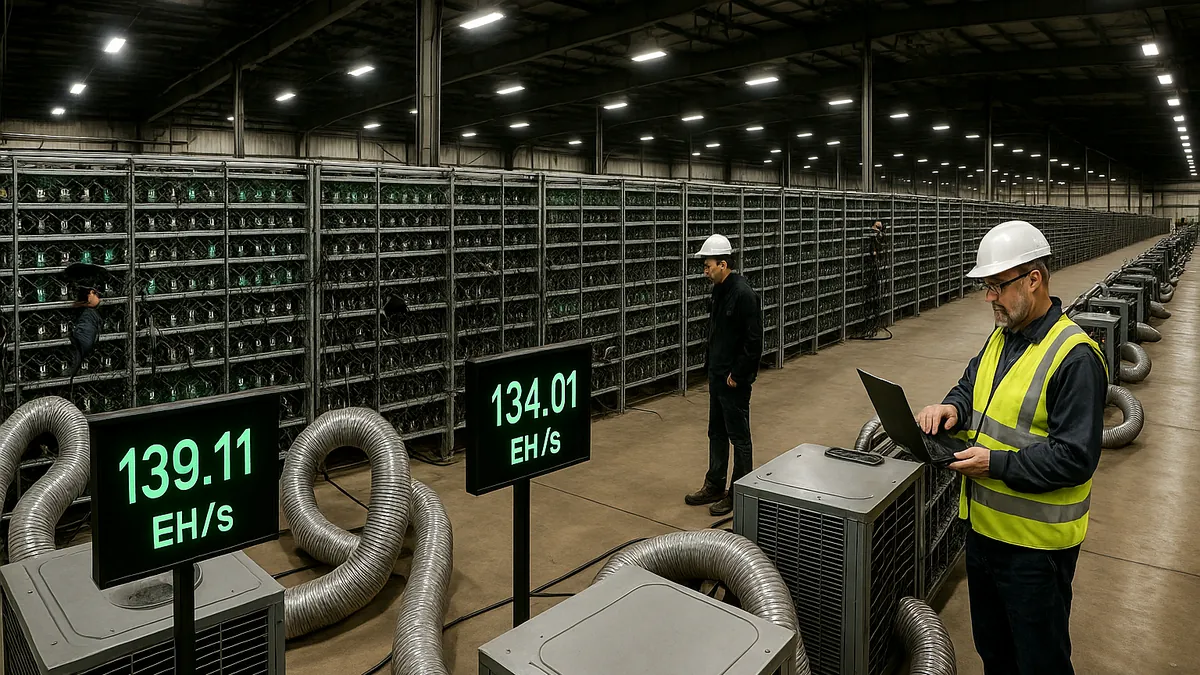
If the Bitcoin sales were mainly a distress signal, the operating data would usually look worse than it does here. Riot’s deployed hash rate increased 26% year over year to 42.5 EH/s by the end of Q1, while average operating hash rate rose 23% to 36.4 EH/s.

Production still declined, but that does not automatically imply weaker execution. After the halving, higher network difficulty can reduce Bitcoin output even when a miner adds machines and expands fleet capacity, so lower coin production alongside higher hash rate is not a contradiction.
Power economics also improved materially. Riot said all-in power costs fell 21% to 3.0 cents per kWh from 3.8 cents a year earlier, helped by $21 million in power credits from ERCOT and MISO demand-response and curtailment programs, which pay participants to scale back consumption during periods of grid stress.
What separates Riot from forced sellers
Across the mining sector, selling pressure has increased as energy costs rise and geopolitical tensions feed volatility in power markets. Less efficient operators have been shutting down rigs, which can reduce network hash rate and eventually ease mining difficulty for better-capitalized firms.
Riot does not fit neatly into that weaker-miner bucket in this quarter’s data. Its lower all-in power costs, larger operating fleet, and access to grid-program credits suggest a company managing liquidity from a position of relative efficiency, even if it is still exposed to post-halving revenue compression like the rest of the industry.
The practical difference for investors is that not all miner selling carries the same information. When a company sells Bitcoin while cutting capacity or losing cost control, the sales often point to balance-sheet strain; when it sells while expanding infrastructure and improving unit economics, the sales are more likely part of capital allocation.
A faster way to read the quarter
The main question is not whether Riot sold Bitcoin. It is whether the company is liquidating to survive or reallocating capital toward a different business mix.
| Checkpoint | Q1 2026 reading | What it suggests |
|---|---|---|
| Bitcoin sold | 3,778 BTC for $289.5 million | Large liquidity raise, bigger than quarterly production |
| Bitcoin mined | 1,473 BTC, down 4% year over year | Post-halving and difficulty pressure remain real |
| Hash rate | 42.5 EH/s deployed, up 26% | Capacity expansion continued despite lower production |
| Power cost | 3.0 cents/kWh, down 21% | Efficiency improved rather than worsened |
| Treasury position | 15,680 BTC held, including 5,802 restricted | Balance sheet is smaller and less fully liquid than the headline total implies |
| Use of funds | AI and HPC data center expansion, including Corsicana | Supports the case for strategic treasury monetization |
The next test is whether selling persists as AI buildout accelerates
Riot’s Q2 production and sales data will matter more than the Q1 headline by itself. If coin sales remain elevated even as infrastructure spending ramps, investors may start treating the company less like a miner with a large Bitcoin treasury and more like a digital infrastructure operator using Bitcoin as a funding source.
Management commentary around full Q1 results and appearances at investor events in May 2026 in New York, Hong Kong, and Los Angeles should help clarify that path. The useful checkpoint is not simply whether Riot keeps selling, but whether future sales are matched by visible progress in AI capacity, stable power economics, and sustained hash-rate expansion.
Short Q&A
Does selling more BTC than Riot mined in the quarter automatically mean stress?
No. In this case, the operating and cost data do not show the kind of deterioration that usually accompanies forced selling.
What is the most important constraint inside the treasury number?
Of Riot’s 15,680 BTC at quarter end, 5,802 were restricted, so not all holdings were equally available for immediate monetization.
What should investors watch next?
Q2 sales versus production, plus whether Corsicana and related AI infrastructure spending becomes more visible in earnings and management guidance.
About the Author