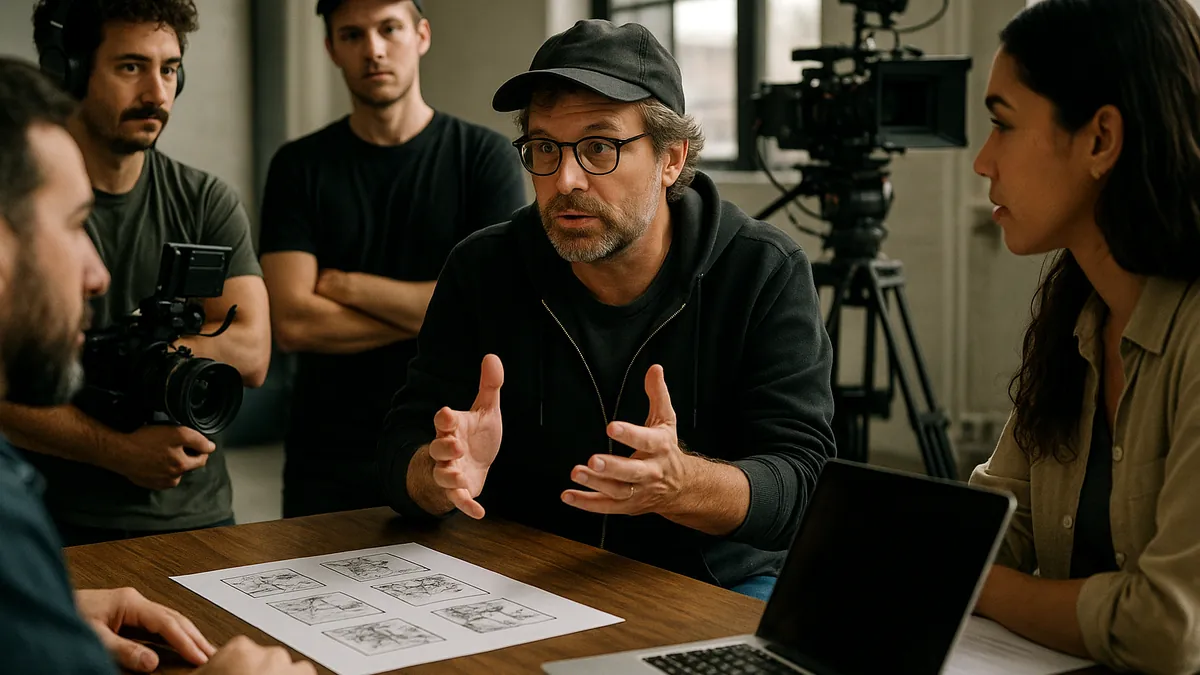
At SXSW 2026 in Austin, Steven Spielberg drew a boundary that is becoming harder for the film business to keep clear: he supports AI as a tool, but not when it takes over work meant for writers and other creative contributors. His test was specific, not abstract. He said he has never used AI in any film or TV project, and that in his writers’ rooms “all the seats are occupied,” with no AI “empty chair with a laptop.”
Spielberg’s actual position is narrower than a blanket anti-AI stance
The easy misread is to treat Spielberg’s comments as technophobia. That does not fit either his remarks or his career. He has long built films around advanced technology and artificial intelligence, including A.I. Artificial Intelligence, Minority Report, and Ready Player One. The line he described at SXSW is about authorship and decision-making, not about banning software from a production environment.
That distinction matters because “uses AI” now covers very different activities, from workflow assistance to synthetic writing and scene generation. Spielberg’s point was that the creative chain still needs identifiable human ownership. In practical terms, he is rejecting AI as a substitute for a writer, not claiming that every machine-assisted production process is illegitimate.
The industry is moving capital toward AI whether directors like it or not
Spielberg’s comments landed as studios, platforms, and startups keep pushing AI deeper into production. Independent filmmakers are being pitched AI tools as a way to cut costs, speed up editing, streamline previs, and reduce staffing pressure. That sales pitch is strongest where budgets are thin and time is short, which means adoption pressure will not be distributed evenly across the market.
Institutional money is also making the shift harder to dismiss as a fringe experiment. Netflix’s reported $600 million acquisition of Ben Affleck’s AI filmmaking company is a concrete example of capital moving toward AI-enabled production infrastructure. Deals like that do not prove AI will replace creative labor, but they do show that major buyers expect these tools to shape workflow, budgeting, and bargaining power across the sector.
For that reason, Spielberg’s stance reads less like a nostalgic holdout than a governance argument: if AI enters production, who controls the creative threshold where assistance becomes displacement?
Where the line sits in practice
The current debate is not simply “AI or no AI.” It is about which functions stay human-led as tools get better and cheaper. Spielberg’s insistence on fully human writers’ rooms gives one clear rule. The broader industry still lacks a shared version of that rule, especially for lower-budget productions under pressure to do more with fewer people.
| Use case | Fits Spielberg’s SXSW boundary | Why the distinction matters |
|---|---|---|
| Workflow assistance, planning, technical support | Potentially yes | These uses can improve speed or cost without claiming authorship over story choices. |
| AI generating scripts, story beats, or replacing room participants | No | This is the “empty chair” problem Spielberg explicitly rejected at SXSW 2026. |
| Hybrid systems where humans edit AI-originated creative material | Unclear and contested | This is the zone where studios may claim augmentation while labor sees substitution. |
That middle category is the real battleground. If AI drafts the material and humans merely refine it, the credit, bargaining, and labor questions change fast. That is the checkpoint the industry still has not resolved, and it is where Spielberg’s comments remain most relevant.
His warning extends beyond software to the kind of storytelling the market rewards
Spielberg also tied the AI debate to a wider concern about attention and format. At SXSW, he criticized a digital culture shaped by short-form platforms such as TikTok and Instagram, arguing that they train audiences toward compressed, fleeting narrative habits. His defense of films that ask for patience was not separate from his AI comments; both arguments favor slower, more collaborative, human-shaped storytelling over optimized output.
That connection matters because cost pressure and attention pressure often push in the same direction. If executives believe audiences want faster, shorter, and more instantly legible stories, AI tools become easier to justify as production accelerants. Spielberg is arguing for a different standard: films should not be rebuilt around the logic of frictionless content supply, and the communal theater experience still depends on craft that cannot be reduced to automated throughput.
The next checkpoint is not adoption, but displacement
AI is already entering filmmaking. The more useful question is where producers, writers, and directors decide that assistance has crossed into replacement. Spielberg’s position gives one firm answer for his own productions, but the market will be defined by whether studios adopt similar limits or leave the boundary vague.
If future announcements focus on scheduling help, planning tools, or post-production efficiencies, the industry can still argue that AI is augmenting human teams. If the language shifts toward reducing writers’ room participation, replacing development labor, or treating creative roles as optional overhead, the line Spielberg drew in Austin will have been breached in exactly the place he warned about.
Short Q&A
Is Spielberg opposed to all AI in filmmaking?
No. Based on his SXSW remarks, he opposes AI replacing human creatives, especially in story development.
What makes his comments notable now?
They come as major companies and investors are funding AI production tools, including Netflix’s reported $600 million acquisition tied to Ben Affleck’s AI filmmaking company.
What should readers watch next?
Whether AI is kept to workflow support or moves into credited creative functions such as writing, development, and other decision-making roles.
About the Author